


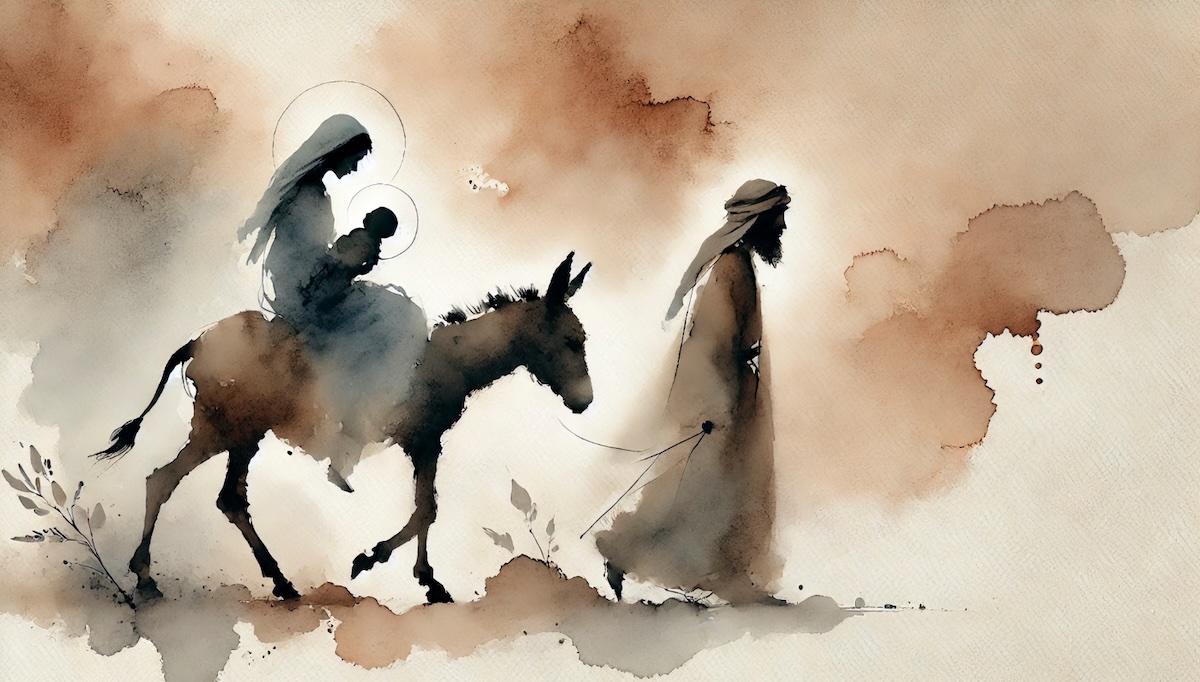
Each year at Christmas, Christians gather around a story so familiar that many of us could recite it from memory. We tell of shepherds under a silent sky, angels bursting into song, a newborn wrapped in swaddling cloths and laid in a manger, a mother and father leaning close in wonder.
We’ve heard the elements so many times that they can feel almost automatic. But if we attend to the story closely — if we soften our assumptions and hear the Gospel accounts of the birth of Jesus again with open ears — we may notice that this story is, at its core, about people living on the edges.
It is a story of vulnerability, displacement, marginalization and divine presence revealed far from the halls of empire.
We are living in an age when many people in the United States feel misunderstood, overlooked and persecuted — whether because of their faith, their political convictions, their economic insecurity, the color of their skin or their immigration status.
So many of us have been feeling grave concern for our Somali neighbors, who have been singled out for an ICE offensive in our region, and have been pained to hear of the steps our Latino neighbors have taken to ensure safety.
Perhaps this is a good time to remember that the Christmas story is not a triumphant tale told from the center but a narrative whispered from the margins. It is a story that invites each of us to find ourselves in it — an iconic story that, even if you are not Christian, you may find resonant.
A poor family in an occupied land
The story begins in poverty. Luke’s Gospel makes this clear when it sets the nativity in the context of taxation under the Roman Empire: “In those days a decree went out from Emperor Augustus that all the world should be registered” (Luke 2:1).
The census was not a neutral population count; it was a mechanism for extracting resources from conquered people. Joseph and Mary are forced to travel not by choice, but by imperial command.
Luke tells us the Holy Family was turned away from normal lodging: “There was no place for them in the inn” (Luke 2:7). This is not a detail of quaint inconvenience — it is a reflection of their social position.
They were not people of status. They were not people with connections. They were not people with means.
Jesus is not born in a palace, but in a place where animals were kept, laid in a manger because a more dignified space was unavailable.
Many people today know what it is like to feel that there is “no place for them” — no place in public discourse, no place in political conversation, no place in the institutions of society, no place where their dignity is naturally assumed.
I’ve recently seen people report posts in social media groups that were simply intended to be informative, resulting in those posts being pulled and voices being silenced.
The Christmas story acknowledges that God’s love is born precisely among those who live outside the circles of privilege, and that important news may be theirs. Throughout his life, Jesus calls his followers to attend carefully to those voices — particularly those that are suppressed or ignored.
Welcomed first by the marginalized
In the narratives of Luke, the first to hear the news of Jesus’ birth are not governors, chief priests or elite citizens — they are shepherds (Luke 2:8–16).
Shepherds in first-century Judea were not respected figures in the community. They were considered socially suspicious: poor, often transient, regarded as unclean and frequently distrusted.
Yet they are the first to receive the angelic proclamation: “To you is born this day in the city of David a Savior, who is the Messiah, the Lord” (Luke 2:11).
This reversal is not accidental. It is theological. It tells us something essential about God’s priorities.
Again, it affirms that those who stand at the edges of society — economically, socially and politically — are the ones God consistently draws near to and uplifts.
In our own time, many people feel pushed aside because of their religious convictions; others because of their race or immigration status; others because of their economic precarity; others because of their gender identity or orientation.
The Nativity does not minimize this pain. Instead, it reminds us that when God chose to enter human history, God’s messengers spoke first to people who knew exclusion firsthand.
A family under threat
In the Gospel of Matthew, we encounter a darker nativity story than the one told by Luke.
Shortly after Jesus’ birth, King Herod feels threatened by rumors of a newborn king. In response, he orchestrates violence against innocent children (Matthew 2:16).
To protect Jesus, Joseph must act quickly. Matthew writes: “An angel of the Lord appeared to Joseph in a dream and said, ‘Get up, take the child and his mother, and flee to Egypt, and remain there until I tell you’” (Matthew 2:13).
In the wake of this angelic exhortation, the Holy Family becomes refugees, fleeing across borders to escape a tyrant.
They settle in a foreign land, Egypt, apart from their friends and family, and we might presume dependent on the hospitality of strangers. Later, when Herod dies, they return — but not to their hometown.
Fearing Herod’s successor, Joseph instead settles in Galilee (Matthew 2:19–23), a region known for its distance from Jerusalem, the religious and political center.
At Christmas, we might remember that Jesus begins his life as one pursued by violent power. His family’s instinct for survival — fleeing danger, seeking safety, rebuilding their lives in an unfamiliar place — is an experience shared by countless people today.
Immigrants and refugees around the world know this reality intimately, including many people here in Minnesota. This is also true of those whose threats are often less visible — people fleeing domestic violence, families who are unhoused and trying to escape poverty, individuals seeking refuge from hatred or discrimination.
Seen through this lens, the Holy Family becomes a powerful symbol of courage in the face of fear, resilience in the face of displacement and divine presence amid uncertainty.
Empire and the human heart
Later in his ministry, Jesus teaches that the kingdom of God looks nothing like the kingdoms of this world: “The greatest among you will be your servant” (Matthew 23:11).
He blesses the poor (Luke 6:20), welcomes outsiders (Luke 5:29-32), defends the vulnerable (John 8:1-11) and proclaims liberation (Luke 4:18-19). The seeds of this vision are visible in the birth narratives.
Christmas does not promise that empire disappears. But it does proclaim that empire does not have the final word.
When people today say they feel singled out or persecuted, that feeling deserves compassion and honest listening — not reports to social media administrators.
Some of our neighbors are experiencing real threats: religious discrimination, racism, anti-immigrant rhetoric, rising antisemitism and Islamophobia, gender-based violence and economic exploitation. Others are feeling cultural displacement — anxiety that their identity or civil rights are being disregarded or mocked.
Experiences may vary, but the emotional core is similar: the fear of being rendered powerless in a system that threatens to be indifferent to their needs.
Christmas proclaims a hope deeper than fear.
So where does this leave us, especially in a season that invites joy but also exposes our deepest wounds?
Whether one feels politically sidelined, socially dismissed, economically strained, culturally overlooked or religiously misunderstood, the birth of Jesus testifies that God understands this terrain from the inside.
Jesus did not arrive insulated from struggle; he was born into it.
Instead of comparing and ranking the severity of hardships, the Nativity beckons us toward empathy. The shepherds who received the good news did not all share the same struggles. The Holy Family carried their own fears.
Yet the story binds them together.
So, too, our communities are strongest when we acknowledge the validity of one another’s experiences and refuse to dismiss another person’s sense of marginalization.
The stories of the nativity push us to widen our compassion. Today’s refugees, migrants, unhoused families and victims of systemic injustice embody the precariousness the infant Jesus knew.
To honor the Christmas story is to refuse to look away from their stories.
Even in the shadow of empire, even on the road to Egypt, even when “there was no place for them in the inn,” God’s light is neither extinguished nor diminished.
It grows quietly — in hearts that welcome compassion, in communities that choose justice and in people who dare to believe that peace is possible.
Editor’s note: This column was written by the Rev. Trish Sullivan Vanni, Ph.D., pastoral director and priest of the Charis Ecumenical Catholic Community in Eden Prairie.
Interested in contributing a faith-based column to EPLN? Email editor@eplocalnews.org.