

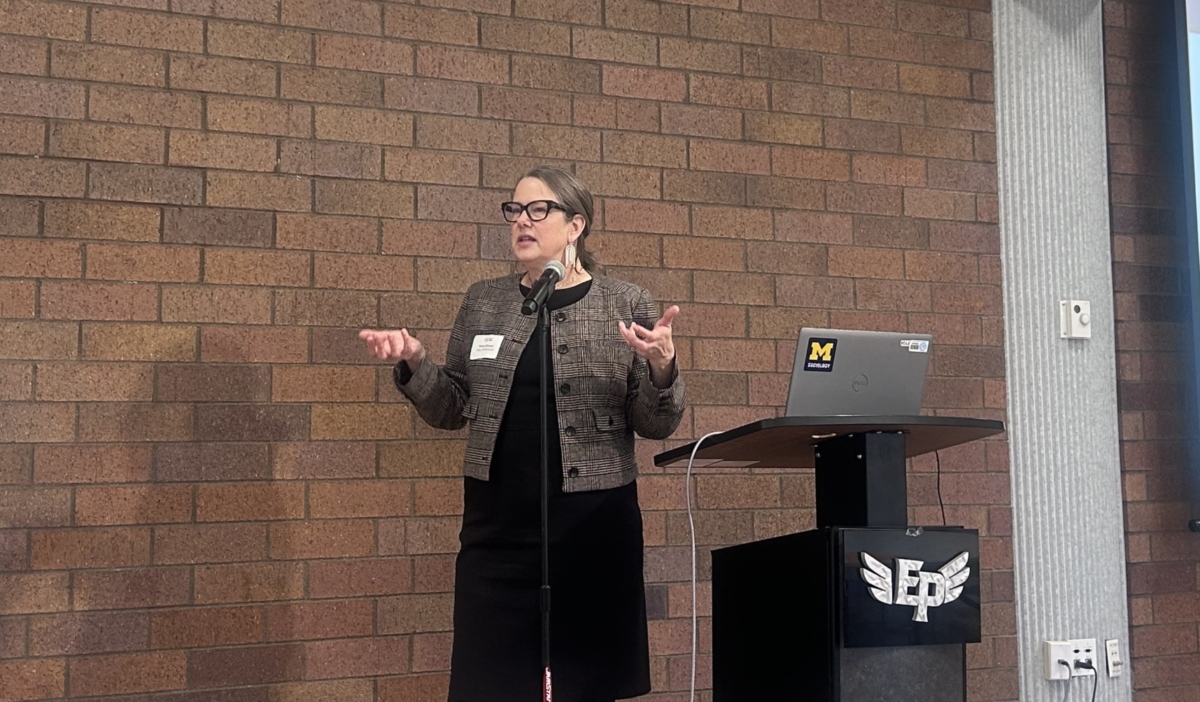
The Minnesota State Demographer, Susan Brower, detailed demographic trends across Eden Prairie and the country at an event hosted by the Eden Prairie Chamber of Commerce at the Eden Prairie Schools’ Valley View campus on Nov. 12.
Conversation topics ranged from slowing population growth to migration patterns, median income and diversity in the community.
The state demographer conducts population projections to assist school districts, counties and other entities in determining what services they may need to offer, or how much their communities will grow over time.
Eden Prairie trends
Eden Prairie, like many suburbs in Hennepin County, grew consistently throughout the 2010s, Brower said. A lot of the growth is attributed to international immigration to the Twin Cities. Entering the 2020s, population growth in Eden Prairie and other suburbs in Hennepin County slowed, some of which is attributed to the pandemic.
Other suburbs, such as Hopkins and Shakopee, however, have seen significant growth, Brower said. These suburbs and other outer-ring suburbs have more land to expand into, driving some of the growth.
Brower said Eden Prairie grew by 0.8% in 2024, whereas Hopkins grew by 4.3% and Shakopee grew by 2.5%.
Eden Prairie is a highly educated suburb, especially in comparison to county, state and national averages, Brower said. Sixty-five percent of residents 25 and older have a bachelor’s degree, whereas 53% of Hennepin County residents and 39% of Minnesotans 25 and older have a bachelor’s degree.
The national average for residents 25 and older with a bachelor’s degree is 33%, Brower said.
The city also exceeds state and national averages for diversity, Brower said. Thirty-one percent of Eden Prairie residents are Black, Indigenous or people of color (BIPOC), compared with 23% of Minnesotans and 42% of Americans.
According to Brower, the largest BIPOC population in Eden Prairie is Asian residents, whereas statewide the largest BIPOC group is Black or African American. Diverse populations in the city and across the state are projected to grow because many of the people of color in the community are children.
“We have more diversity at the younger ages, and so as those young people age up into the parenting years, they will have diverse children as well,” Brower said.
Brower said international immigration also plays a role in racial and ethnic demographics, but the people living in the community now play a larger role than most people realize.
“Sure, immigration plays a role there, but it’s not as dependent on immigration as a lot of people think,” Brower said. “It has to do with who’s living here now, who are Minnesotans now, and who’s the right age to be having children.”
Minnesota trends
Population growth is slowing nationally, across the Midwest and in Minnesota, Brower said. In the United States throughout the 2000s and 2010s, the population grew by about 1% each year, but now it has dropped to 0.6%.
The Midwest as a region is seeing slower population growth, but Minnesota is growing faster than the region.
Families are having fewer children across the country, including in Minnesota, contributing to slowed population growth, Brower explained. The replacement fertility rate — the amount of children a family needs to keep the population stable — is 2.1 children.
Minnesota’s current fertility rate is down to 1.7 children per family, meaning having more children is no longer the driving force of population growth, according to Brower. Migration into the state is instead driving growth.
This trend is consistent globally, as other countries like China and India are also seeing falling birth rates, Brower said.
According to Brower, the biggest contributor to residents migrating out of the state is college-aged people leaving to attend college.
“It’s really a story of young people moving elsewhere for college,” Brower said. “Some of them come back, but not all of them in any given year. And we tend to export more young people than we import around that college age.”
Some students come back after graduation, Brower said, but not all do.
The state also sees population decreases as older people move out of the state during retirement, Brower explained. Many older adults go to places with warmer weather, like California, Texas and Arizona.
“This is an important piece of how we grow,” Brower said. “We’ve been losing about 5,000 to 10,000 people per year, but it’s always fully been made up by international immigration.”
Brower said population growth makes it easier to make improvements and changes to communities.
“Growth is the easy way to solve and address some budget issues,” Brower said. “Growth is the easy way to keep roads paved, to keep infrastructure in place, and we rely on it a whole lot more than you think we do.”