

Helping Paws, a service dog training organization, relocated to Eden Prairie from Hopkins in 2024 to continue its mission of providing service dogs to veterans, first responders and people with disabilities.
The nonprofit began in 1985 at the University of Minnesota’s Center to Study Human-Animal Relationships and Environments but became an independent nonprofit in 1988, Executive Director Alyssa Golob said. Helping Paws aims to increase people’s independence through the assistance of service dogs.
The organization also places dogs in schools and courthouses and provides support for mental health needs, Golob said.
Helping Paws relies on volunteers to assist with breeding, housing and training dogs, she said. Over the past 37 years, the group has trained more than 370 dogs, each trained over the course of 2½ years.
Training from birth through puppyhood
Golob said training begins at birth, based on a Duke University program for the first eight weeks of life. Puppies are desensitized to sounds and smells – such as by crinkling newspaper near their ears – so they are less likely to be distracted later in life.
After eight weeks, the dogs move to host homes, where they receive love, care and basic household training, Golob said. They are brought to Helping Paws’ training center three to four times a week and learn about 80 commands by the time they graduate.
Host homes can foster a dog for either 10 months or 2½ years, said Jonathan Kramer, Helping Paws marketing manager.
Volunteers also help train dogs by attending weekly classes at the Hemak Training Center inside Helping Paws’ office, Golob said.
Karen Hupp, a dog trainer who began working with Helping Paws 14 years ago, said she has trained four dogs from start to finish and taken in about 10 others for shorter periods. She credited Helping Paws for guiding volunteers through the process.
“They’re pretty good at holding your hand. I had dogs my whole life… so I didn’t feel like I was starting from scratch,” Hupp said. “When you start the process and get accepted as a trainer, you go to one or two orientation meetings before you even get the puppy.”
Hupp said her favorite part of working with Helping Paws was training and working with the dogs.
“I love the training. When they learn something, and then they do it joyfully for you,” Hupp said. “It’s really a thrill.”
Finding a dog’s perfect match
Toward the end of the 2½-year training period, Helping Paws staff begin reviewing the waitlist of people seeking a dog, Golob said. The current waitlist is about three years long.
Being at the top of the list doesn’t guarantee a match, she added. The organization uses a detailed process to ensure compatibility between the dog and recipient.
“We bring in a candidate, and they meet with three or four dogs, and our program staff is really just watching the interaction – how the person’s reacting to the dog, how the dog’s reacting to the person – and in most cases, the dog picks the person,” Golob said. “I’ve seen a dog just like, kind of shut down for one person and become totally animated for the next person they meet.”
When a client is matched with a dog, they attend a three-week boot camp to learn the commands the dog knows and how to integrate them into daily life.
Why goldens and Labradors?
Helping Paws breeds only golden retrievers and Labrador retrievers for service work, Golob said. These breeds are well-known to the public and tend to make people feel comfortable seeing them in the community.
Goldens and Labs are also motivated by treats, making them easier to train, Golob said. They can transfer loyalty from one person to another, meaning they transition smoothly from living in a host home to working with a new client.
“After 2½ years of training and they’re with a volunteer, there’s a little bit of an adjustment period, but it’s much harder for the volunteer to let go of that dog than for the dog to start going to work for someone else,” Golob said. “As long as someone’s feeding and treating that dog, that’s where their loyalty will lie.”
These breeds, as their names suggest, are also skilled at retrieving, Golob said.
“That is a big skill we need them to do,” she said. “If you think about someone with a physical disability, if the person’s at the store and drops their credit card, that dog will be able to pick up the credit card and hand it to the cashier.”
Guiding through the adjustment period
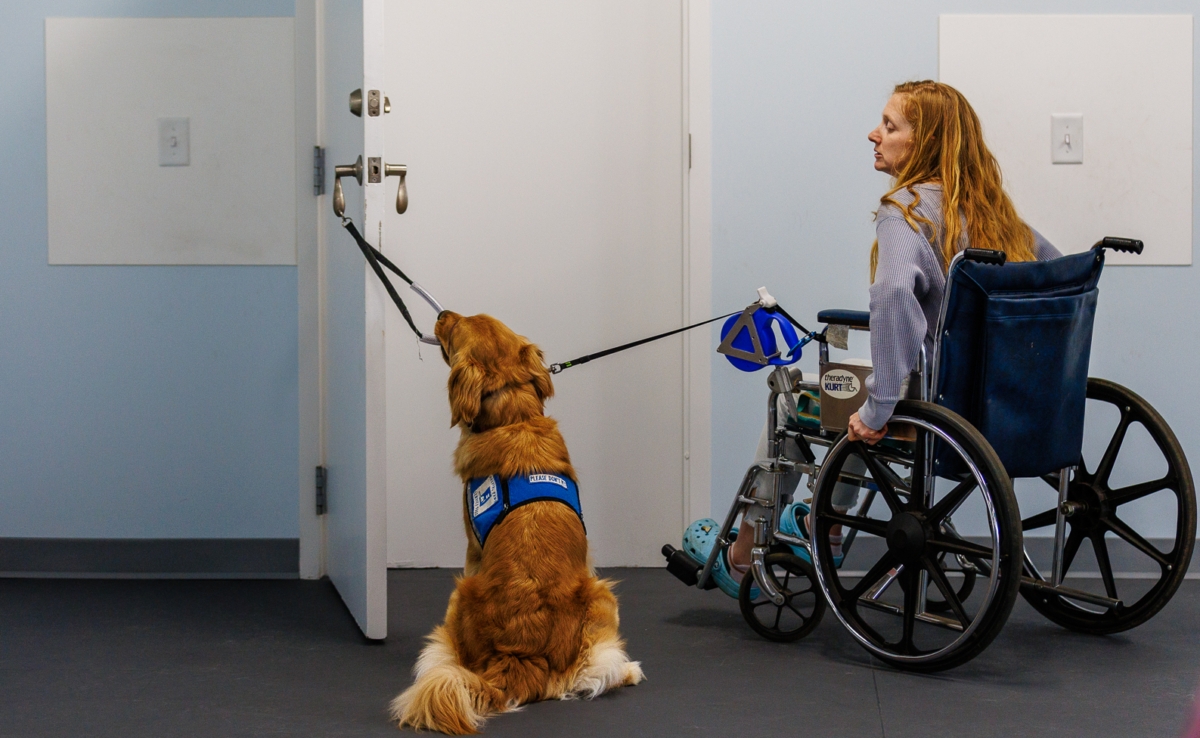
Jenny Beem, Helping Paws’ client coordinator, said the dogs are trained in standard skills to help clients – such as retrieving items, opening doors and performing other daily tasks. They are not trained for more specific needs like medical detection and seizure alerts.
Beem said she helps clients work through difficulties with their dogs as they both adjust to their new environments. She works to find strategies to ease those challenges.
“Some people maybe have had a lot of experience with dogs, maybe some have less experience with dogs,” Beem said. “A lot of times those challenges are something that can be alleviated.”
Beem said when she does not know exactly how to help a client, her colleagues at Helping Paws troubleshoot and find solutions she may not have considered.
Helping Paws also has a second coordinator who works with veterans, Beem said. She works exclusively with people with disabilities.
Golob said it is rare for a dog to be rehomed because it does not click with a client.
Helping Paws’ dogs have a 50-60% success rate of graduating from the training program, Golob said. She aims to raise that to 70% through new training techniques – including early exposure to different sensory experiences for young puppies.
“They don’t graduate for allergies. They don’t graduate because they don’t want to focus on one person. They want to go play with their littermates,” Golob said. “We have really high standards, because this is this person’s new lifeline.”
Golob said the organization primarily serves people in Minnesota, but can serve anyone within a four-hour radius. They have clients in Wisconsin and South Dakota.
The service dogs are valued at $35,000 to $40,000, but are provided at no cost to clients, Golob said. Clients pay a $100 application fee and a $300 materials fee, which can be waived if they cannot afford it.
Aside from working as a trainer or host home, there are many ways for community members to volunteer, Golob said. Volunteers can come to the office to clean crates and spend time with dogs, dog-sit or walk dogs for host homes that are out of town.
Golob said successful service dogs stay focused solely on the person they assist.
“I would say the biggest thing is the dog’s ability to be focused on their person,” Golob said. “A dog who can go through this store and not react to other customers, to children, to babies crying, that are completely focused on their person.”
More to read: Minnesota House Speaker Emeritus Melissa Hortman originally trained her dog, Gilbert, through Helping Paws. Hortman’s Heroes was created to honor Gilbert’s legacy after he died in a June 14 attack on Melissa and her husband, Mark.