

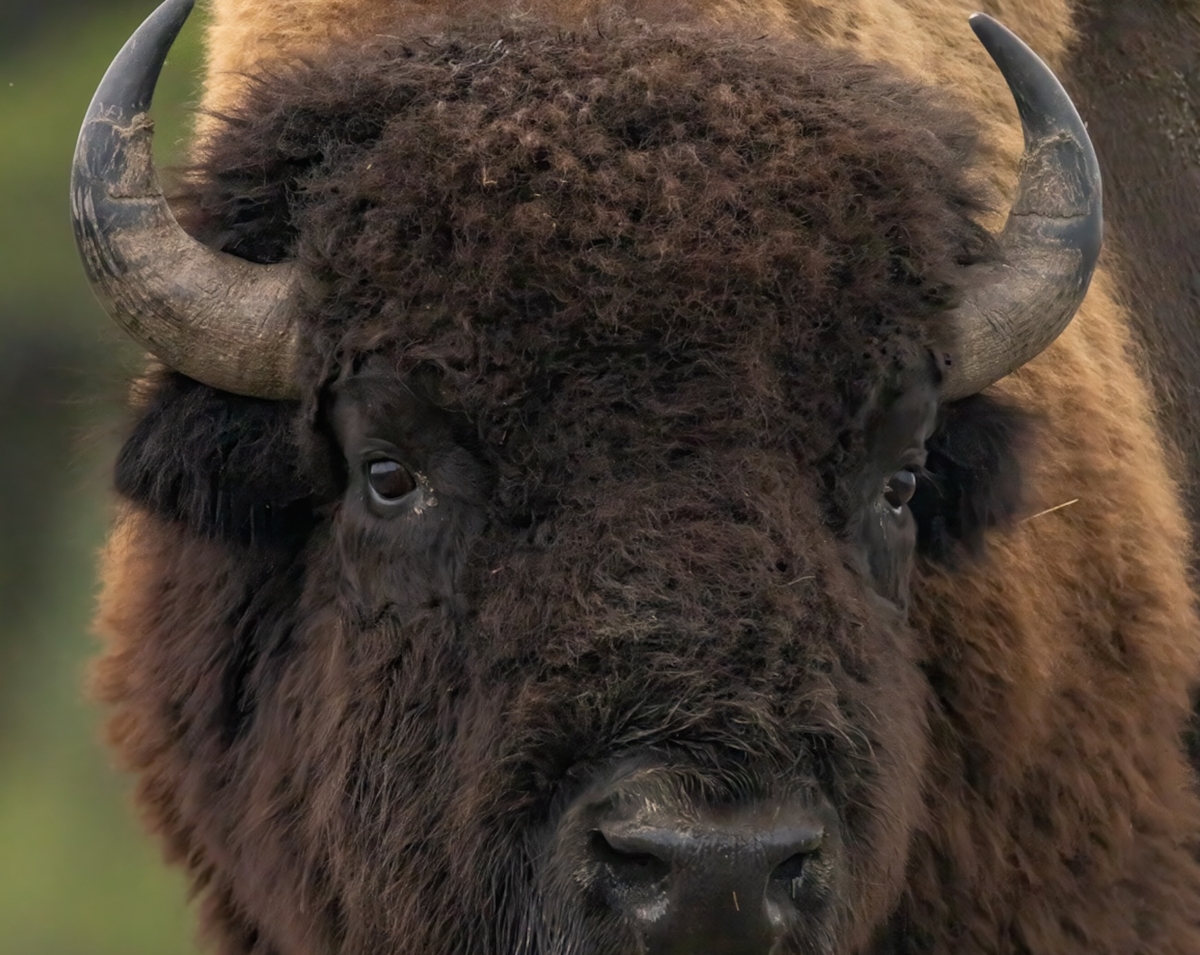

The American bison (Bison bison) is one of those animals that doesn’t seem to get the admiration or respect that other large animals command.
Brown bears, moose and elk are adored by the masses. White-tailed deer are prized, and black bears are respected – yet it seems the bison is just tolerated, kind of like you might tolerate your strange uncle who comes to a family gathering.

Bison are the national mammal of America, and it seems rather fitting. The bison has significant historical, cultural and ecological importance and does a great job representing the strength of America. This critter has gone from being one of the most numerous animals in America in pre-settlement times to being on the brink of extinction and now rebounding. It has an important conservation success story to tell and a good lesson to teach.
The American bison is the largest land mammal in North America. This was painfully obvious to me while I was recently filming and taking pictures of some bison in Theodore Roosevelt National Park in North Dakota. The males were rutting and tending closely to some females. Looking through my camera lens brings the animal up close and personal and really drives home the fact that the males are absolutely huge.
An adult male can stand more than 6 feet tall at the shoulder and 10 to 11 feet in length. Females and young males are much smaller, but an adult male can weigh more than 2,000 pounds – a full ton. The record heaviest bison weighed over 3,800 pounds. Despite their massive size, they are fast and agile, capable of outrunning a horse, reaching 35 mph, and jumping more than 6 feet high.
This is definitely not an animal to trifle with. I was following one large bull when I noticed he wanted to cross a road. The sides of the highway had the standard metal guardrail, which is about 3 feet tall, but this bull didn’t even break stride – he cleared the rail in one clean jump and kept going.
Bison are considered ecosystem engineers, similar to the prairie dog that I wrote about last time. They don’t just graze – they shape the environment around the areas where they roam. Moving around, the bison encourage a wide variety of plants to grow by grazing for a short time before moving on to another area.
They are one of the few species where both males and females have horns. Just a reminder: horns are different from antlers. Horns are permanent structures on the animal’s head and are composed of keratin, while antlers are made mostly of calcium and are regrown each year.
I was out filming a herd of bison that contained several large males, all of whom were rutting. During the breeding season, males go around and check in with females. They smell the female to determine if she is near the optimal time to be bred. As the males wander around, they sound off with a deep and resounding bellow.
These bellows are very loud and sound like a cross between a lion’s roar and a black bear’s growl. The low-frequency wave of the bellow travels well across the open ground. I happened to notice the sides of the bison vibrating with each bellowing call, just where the ribs are located – so much that the dirt and dust in the male’s fur vibrated right out into the air.
It was a truly impressive sight – something I would never have known or understood if I hadn’t spent so much time observing and filming.
We should celebrate our American bison because it’s truly a unique American animal. By the way, I hope you noticed that I never called them buffalo. That’s because they are not a type of buffalo.
Also, Saturday, Nov. 1, is National Bison Day and Awareness Day. This day of celebration is held the first Saturday in November each year.
Until next time …
Editor’s note: Stan Tekiela’s NatureSmart column appears twice a month in the Eden Prairie Local News. Tekiela is an author, naturalist and wildlife photographer who travels extensively across the United States to study and capture wildlife images.
You can follow his work on Instagram and Facebook. He can be contacted via his website at www.naturesmart.com.