

The slides, ladders and splash pad at Miller Park playground the afternoon of June 2 were bereft of children. It was gusty and hot — 90 degrees hot.
A quartet of grownups gathered near the playground’s main entry in the shade of blossoming hawthorn trees. With daylilies and a rustic wood fence, the plantings form a buffer to the parking lot.
One of the four, an alert young man from Kenya, had questions for Amy Markle, Eden Prairie parks and recreation director. Bonface “Bonny” Odhiambo is a landscape architecture student at Colorado State University in Fort Collins.

Markle sparkled with information. The Miller Park playground is a “barrier-free” or “inclusive” playground designed for children who may need a mom, dad or caregiver using a wheelchair to move around.
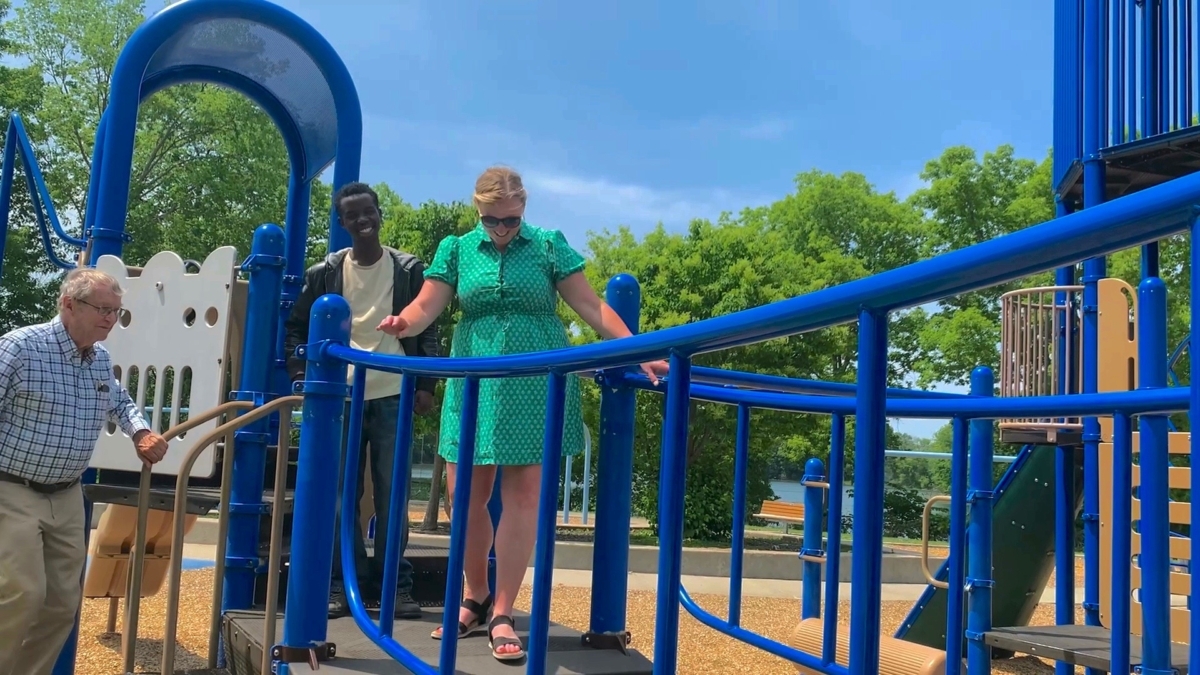
The gentle ramps and elevated walkways at Miller Park are good for wheeling and pausing to figure out next moves — say, to a lookout or roller slide. So, too, are the tinted, wheelchair-friendly, rubberized pathways through woodchip lawns. The green, brown and blue colors, Markle said, add interest.
Eden Prairie Parks Manager Matt Bourne and landscape consultant and educator Jim Knopf contributed to the chat. Knopf is Odhiambo’s American mentor and has lived in Kenya.

A family’s mission
During a walk around the playground, the four lingered next to a cartoonish-looking molded ship with peekaboo portholes. The craft “floats” on the rubberized surface. Both are as blue as a storybook sea. Wheelchair sailors can easily board; their mates have benches at the stern and bow. Onboard, a panel identifies the tub as the “S.S. ASHLEY.”
The Miller Park playground overlooking Mitchell Lake was inspired by 5-year-old Ashley Garvin. Ashley’s young life was defined by cerebral palsy. She could not sit up or walk by herself. Parents Mike and Jenny would carry her up slides and lift her into bucket swings. She loved sliding and swinging. They loved her giggles, but play amenities for kids with special needs were hard to find in Eden Prairie.
That would change. The Eden Prairie News reported in June 2008 that Mike Garvin had been impressed with a barrier-free playground he had seen during one of his travels. He told reporter Leah Shaffer that, “Every part of the playground was accessible by wheelchair.”
Garvin approached the Parks Department about building a barrier-free, ADA-compliant playground. The Parks Department loved the concept. One could be installed as part of a makeover of the then-aging playground at Miller Park. But the added expense of barrier-free play structures would force a wait.
So, Mike and Jenny Garvin became community activists. They organized a team of volunteers and got help from the Tom and Kathy Miller Family Foundation. Two years later, they had raised $211,000 — enough for the first of three phases that would become the barrier-free playground that still serves kids today.
Eden Prairie CityTV documented the Nov. 18, 2008, City Council meeting that accepted the final $76,650 portion of the donation. Jay Lotthammer, parks and recreation director at the time, noted that the project, with its wheelchair-friendly amenities and tactile and sensory features, could be the first of its kind in Minnesota.
Presenting the check to a deeply appreciative then-Mayor Phil Young, an emotional Mike Garvin thanked the city and donors. “This project started over two years ago,” he said, “and for that dream to start becoming a reality is quite overwhelming for me.”
Seventeen years later, this June, Markle, Bourne, Odhiambo and Knopf were smiling as they walked over a slatted bridge that wobbles with each step. It was designed that way to be fun, safe and wide enough for wheelchairs and baby strollers.

Knopf tested a set of chimes, spotted a tic-tac-toe game, a vertical xylophone and several markers written in braille, all easily reachable for children who use wheelchairs.
Markle pointed out a “transfer station,” where kids can lift themselves from wheelchairs onto a platform and then safely climb steps on their own, without standing, to a lookout and slide.
Odhiambo appreciates the aesthetic and leafy shade merits of trees, but had a question. “When it comes to design, do you think we should use native plants?” Waving his hand at the hawthorns, he stated, “This kind of planting can be expensive.”

Nairobi
Bonny Odhiambo calls the port city of Kisumu, on Lake Victoria in western Kenya, his home. Like many promising youth, he moved to Nairobi to further his education; he is a graduate of Lenana Secondary School. The mile-high, equatorial city embraces Nairobi National Park, where safari tourists often take selfies with giraffes, lions and skyscrapers in the background.
Nairobi counts an estimated population of 5.7 million people. By comparison, the seven county Twin Cities region numbers about 3.2 million.
Nairobi features traditional villages with maize and banana groves, but its core of crowded street markets, beautiful parks, ragtag to elite residential enclaves, slums and skyscrapers forms a patchwork urban quilt. Its playgrounds range from tourist-oriented spaces with admission fees to others crafted with slum-smart ingenuity from old tires, cardboard and scrap.

Several Google searches for barrier-free/inclusive playgrounds in Nairobi revealed none. Such playgrounds may not be detected with data center-powered algorithms. The small playgrounds that do exist on private and public parcels are sometimes viewed as developable land for housing or commercial space.
“We don’t have the huge economic resources that they have here in the States,” said Odhiambo. “But we can build accessible play structures from wood and available materials.”

With Nairobi’s densely packed business and residential sections in mind, Knoph said that “children have no place to play. …There is no city parks department.” Streets are clogged with cars, pedestrians, delivery vans, hand carts, buses, minibuses (matatus), and motorcycles.
Jim Knopf would know. Since serving in Kenya as a Peace Corps volunteer in the late 1960s, he has returned to Nairobi regularly on education projects. We first met in 1969 under a mango tree in Ngora, Uganda, where I was a Peace Corps teacher. Serendipity connected us to East Africa and Eden Prairie. Several tented safaris are part of our story — a yarn best shared with others under a mango tree or at Lions Tap.

The Eden Prairie connection
While studying landscape architecture at the University of Michigan, Jim found related summer work with Brauer & Associates, the firm that drafted Eden Prairie’s 1968 guide plan and helped shape the city’s shoreline protection ordinances.
Over the years, working from his base in Boulder, Colorado, my friend became an author, consultant and lecturer on xeriscaping (dry-climate landscaping). During visits to family in Bloomington and Chanhassen, I took Jim around our rapidly evolving suburb to see Town Center, Birch Island Woods, The Preserve, Hennepin Village and Miller Park’s barrier-free playground.
More recently, the Minneapolis Foundation helped Jim set up a foundation that enables him and his Kenyan partners to financially support and mentor promising Kenyan students. One of them, Bonny Odhiambo, was interested in urban design.
Jim and Bonny came to the Twin Cities in June to study the Minneapolis parks system, regional bike trails, light-rail stations and to see the inclusive, barrier-free playground in Miller Park.
Miller Park playground’s future
Eden Prairie Local News recently learned that the playground is due for another makeover. In January, the Parks and Recreation Department will begin drafting a capital improvement plan for its full renovation.
If approved by the City Council in December 2026, the project will install new and more inclusive, barrier-free playground elements. City policy calls for equipment upgrades every 15 to 20 years or as needed for each playground. All future upgrades will feature inclusive, barrier-free play equipment.
These kinds of playgrounds, Markle said, have proven to be more enjoyable for everyone — for children with or without disabilities, because they can play together.

Odhiambo and Knopf learned from their two guides that the planning process for major playground rebuilds in Eden Prairie includes input from neighbors, kids, parks staff, the Planning and Parks commissions, consultants and playground equipment vendors. Playgrounds aren’t simply plugged in.
“We may go through two, three, or four iterations of a playground,” Markle said, “but ultimately we land on a design that has a lot of community input.”
Knowing that playground funding per project in Nairobi or Kisumu is significantly smaller than in Eden Prairie, Odhiambo shared this thought: “The concepts here in Eden Prairie can work in Nairobi as well.”
Postscripts
• Bonny Odhiambo attended the annual conference of the Society of American Landscape Architects in New Orleans in October. He was one of four Colorado State University landscape architecture sophomores selected to make the trip.
______________________________

• Eight years after the approval of the Miller Park Playground donation, Ashley Garvin and her family showed up for the November 2016 grand opening of Edina’s first inclusive, barrier-free playground.
Rosland Park Universal Playground is laid out in a glade hugged by oak trees next to Lake Cornelia. An EdinaTV report of the ribbon-cutting ceremony features clips of Ashley’s mom, Jenny, with lots of happy kids; sound bites from Edina Mayor Jim Hovland; Jenny’s dad, Mike; and footage of Ashley being wheeled along a catwalk.
The Garvins had moved to Edina. With four kids, they continued to keep their eyes on the prize of inclusive playgrounds for everyone in all communities.
Ashley Katherine Garvin passed away on May 18, 2024. She was 21 years old. Ashley’s obituary notes that she was a “graduate of Edina High School, loved music, riding her bike, going in her swing, and spending time with friends and at her family’s cabin up north.” She had an infectious laugh.
Editor’s note: Jeff Strate is a founding board member (retired) of Eden Prairie Local News.

VIDEOS TO WATCH