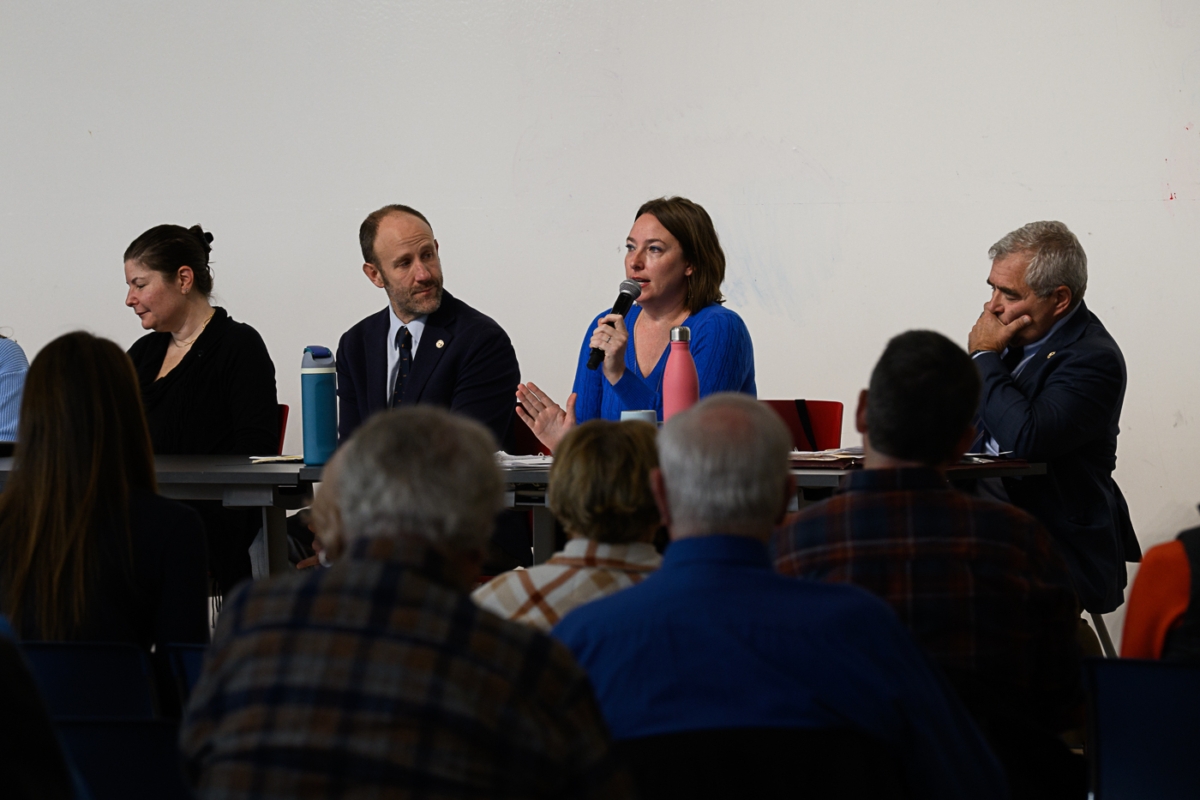
Rep. Carlie Kotyza-Witthuhn speaks during Saturday’s gun-violence town hall at Central Middle School, flanked by Rep. Alex Falconer and Sen. Steve Cwodzinski. At far left is Rana Alexander of the Hennepin County Attorney’s Office. Photo by Jeremy Peyer
Sen. Steve Cwodzinski and Reps. Alex Falconer and Carlie Kotyza-Witthuhn — Eden Prairie’s DFL state legislative delegation — held a town hall at Central Middle School last Saturday to discuss gun violence, drawing about 70 people.
Representatives from the Hennepin County Attorney’s Office and Southwest Metro Moms Demand Action joined the conversation to provide legal and activist perspectives on the issue. Audience members submitted questions for the legislators to answer when registering for the event.
The discussion came amid several tumultuous months in Minnesota. House Speaker Emeritus Melissa Hortman and her husband, Mark, were assassinated in June, and two months later a shooting at Annunciation Catholic School in Minneapolis left two children dead and 28 others injured.
Why it matters
Cwodzinski said his years teaching government at Eden Prairie High School pushed him to advocate for stricter gun control, often having to talk with students after mass shootings.
“I truly love teaching, and yet there were times I struggled, and I couldn’t find the words when I walked into the classroom, because there are no words,” Cwodzinski said. “And the looks on my students’ faces when I told them we had another school shooting today, and the looks of disbelief and distrust and doubt and the failure in US adults to try to keep our kids safe.”
Falconer said he has had difficult conversations with his high school-aged kids about gun violence in schools and how to get in contact with their parents with cell phone bans in their high school.
 About 70 people attended the town hall. Photo by Jeremy Peyer
“The first day coming home from school, their comment back was, ‘Well, how am I supposed to say goodbye if something happens?’” Falconer said. “The fact that we are choosing … to keep that system in place where our kids are afraid to go to school, and they’re worried actively that somebody is going to come in and could potentially aim a gun at them, and they don’t know how they’re going to say goodbye to their parents, because we have a new cell phone policy, that’s important.”
Kotyza-Witthuhn said part of what motivates her to push for gun reform is the belief that she can help create a better world for her children.
“I keep doing this job because I believe that we can leave a better place for our kids,” Kotyza-Witthuhn said. “We can change the laws to help keep them safer and protect them and protect all of us.”
Extreme risk protection orders
Rana Alexander, an assistant attorney at the Hennepin County Attorney’s Office, said Minnesota passed a red flag law, formally known as extreme risk protection orders (ERPOs), in 2023 under the supervision of the late House Speaker Emeritus Hortman.
If a person is behaving in a concerning way — whether they pose a threat to themselves or to others — and has access to a firearm, a petitioner can ask the court to temporarily restrict that access, Alexander explained. The order can last up to 14 days, and petitioners must return to court if they want it extended.
“We actually have a pretty high standard to be able for the court to grant this order for past that 14 days,” Alexander said.
People like Bridget Liverca, a legal service specialist at the Hennepin County Attorney’s Office, meet with families or household members to help determine whether filing an extreme risk protection order is in their best interest. She also works with local leaders to ensure communities know the service is available.
“We meet with the police departments,” Liverca said. “We’ve sent out emails to mayors and city council members to let them know how important this law is, and to make sure the community knows that this is available to them as well.”
Liverca said she also trains individuals on safe gun storage through her position. Hennepin County also offers free gun locks at 11 libraries around the county.
She also encouraged speaking with school districts to promote safe gun storage in newsletters and to educate parents on how to file an ERPO if necessary.
“Those are the two things that we can do right now,” Liverca said.
Ideas lawmakers and advocates raised
Kathy Kraemer, a co-leader at Southwest Metro Moms Demand Action, noted that Minnesota ranks 14th in the nation for gun safety, but about 500 Minnesotans are still killed by guns each year — including 40 children. She said the number of guns in the country directly contributes to the number of deaths.
“I think an obvious thing is the number of guns in the United States — we are off the charts compared to every other country,” Kraemer said. “There’s more guns than people in the United States, so that’s a contributing factor.”
Kraemer said the state could take several steps to reduce deaths from gun violence, including holding gun owners accountable if unsecured firearms are used in a suicide and requiring the reporting of stolen firearms.
 Sen. Steve Cwodzinski and other legislators spoke with constituents after the panel. Photo by Jeremy Peyer
Cwodzinski, chair of the Senate Education Policy Committee, said incorporating school resource officers into more schools could help keep students safe. He also noted that Minnesota is ranked 46th for school counselor-to-student ratios, something he deems problematic.
“When a kid needs to see a counselor and they’re told, ‘we can get fit in a couple weeks.’ That doesn’t cut it with a kid that’s going through a mental crisis,” Cwodzinski said.
Kotyza-Witthuhn said school resource officers can be an effective way to keep schools safe, but it depends on a community’s relationship with law enforcement. She praised Eden Prairie Schools for its school resource officers’ strong relationships with students and staff.
“I think that it is not that’s not something that we should necessarily mandate across all districts, because there are districts where the relationship with law enforcement is fraught,” Kotyza-Witthuhn said. “But our Eden Prairie police do such amazing community outreach.”
Each legislator said they supported a statewide assault rifle ban.
Falconer cited assault-weapon bans abroad and in the United States that have sharply reduced mass shootings. Australia, for example, banned assault weapons in 1996 and has had only one mass shooting since.
The United States banned assault weapons from 1994 to 2004, leading to a 37% decrease in mass shootings, Falconer said. When the ban expired, mass shootings increased by 183%.
Falconer said the state already has a definition of what an assault rifle is, meaning there would not be questions about what weapons fall under the category. A ban would also likely not call for forced removal of weapons.
He also noted that there are already restrictions on which weapons civilians can have, as they cannot have weapons of war.
“We have a choice as a society on what weapons we want to allow the general citizen to possess, to sell, to manufacture. So I don’t see it as limiting semi-automatic weapons as a strike against the Constitution,” Falconer said.
Kotyza-Witthuhn said enacting mandatory waiting periods, universal criminal background checks and a requirement for a written test before being able to own a gun could all prevent deaths from guns. Currently in Minnesota, gun owners must take a class to learn how to safely own a gun but are not tested on whether they retained the material.
“You are bound by law, as somebody who carries a weapon or owns a gun to know all of those statutes and everything that they taught you in that test or the end of the class,” Kotyza-Witthuhn said. “But you’re never required to prove it until you do something bad, and then it’s clear that you were not paying attention.”
She also noted that requiring safe storage, with guns and ammunition locked in separate safes, would also greatly decrease gun deaths.
Cwodzinski noted that the Second Amendment begins with the words “a well regulated militia,” which he said implies there should be restrictions and limitations on weapons.
“The original intent was that with a well regulated militia, there should be restrictions, there should be limitations,” Cwodzinski said. “There should be a test, maybe, but a well regulated militia is necessary for the security of a free state, the right that people can have to keep and bear arms and not be infringed or denied.”
Kotyza-Witthuhn noted that the Legislature will not hold a special session to address the issue and will instead wait for the legislative session to begin in February.
Falconer said the Legislature cannot make progress on issues if constituents do not make their voices and opinions heard because the House is tied, making it difficult to pass legislation in a special session.
“We really can’t go forward without the support of people who also agree with us in wanting this to happen,” Falconer said. “So please look for organizations like Moms Demand Action. Get involved. Raise your voice.”