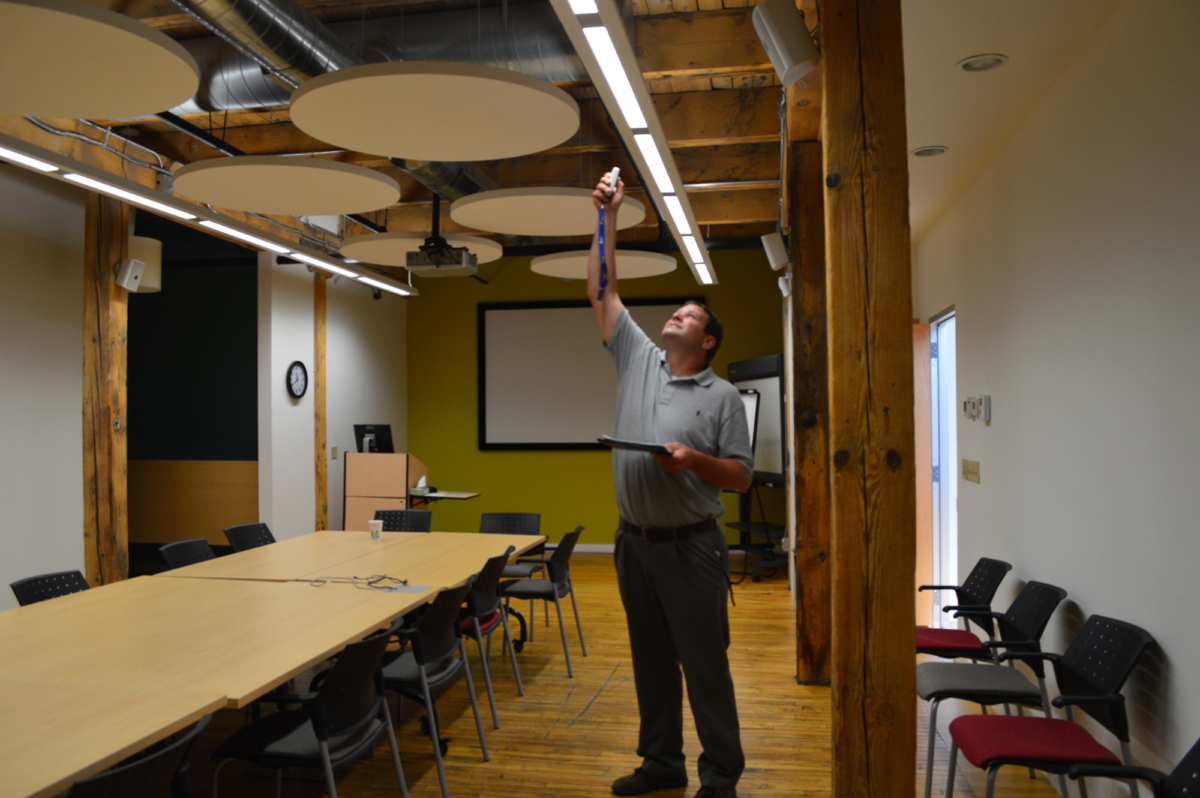
The sale of fluorescent lamps, also known as lightbulbs, will be banned in Minnesota as of Jan. 1, 2026. Consultants from the Center for Energy and Environment (CEE) conduct on-site assessments that review lamps and other energy users. Photo courtesy of CEE
Businesses, nonprofit organizations and other commercial customers who are still using fluorescent lightbulbs need to know an important upcoming deadline.
On Jan. 1, 2026, Phase 2 of Minnesota’s Clean Lighting Law goes into effect. When it does, consumers and businesses will no longer be able to buy any kind of fluorescent lightbulbs in the state of Minnesota.
Phase 1 of Minnesota’s Clean Lighting Law went into effect on Jan. 1, 2025. That phase banned the sale of screw- and bayonet-base compact fluorescent lamps (CFLs). When Phase 2 goes into effect, the sale of pin-base linear and compact fluorescent lamps will be banned.
Within the regulation, the word “lamp” is used to refer to what are commonly known as “lightbulbs.” Screw-base CFLs attach to a light socket when a user screws them in. Bayonet-base CFLs attach to the socket via one or two protruding studs on the side of the base. Pin-base lightbulbs attach to a socket through protruding or recessed pins on the bottom of the base.
CFLs have one base, which can be shaped in a spiral, coil, circle, or folded. A linear fluorescent lamp has two bases, or end caps, and may be straight or folded, often called a U-bend.
“The ban on selling these lamps in the state of Minnesota is Jan. 1, 2026,” said Mark Rader, lighting consultant for the Center for Energy and Environment (CEE). “This includes both commercial and private sales. You’ll have to drive out of state to buy one.”
Minnesota’s Clean Lighting Law, regulated by the Minnesota Pollution Control Agency (MPCA), was meant to reduce mercury exposure in the environment. The law has exceptions for bulbs currently in use. These can remain in place until they burn out. There are also exceptions for products that require their use, like photocopiers and printers.
Rader pointed out that it is difficult to estimate the number of fluorescent bulbs that are still installed in homes, schools, houses of worship, warehouses, factories or other types of businesses or public places.
“I have the feeling the Jan. 1, 2026, deadline is going to catch a lot of folks off-guard,” Rader said.
Free energy assessments for commercial properties
For those who are still using fluorescent lamps, there is help available: the One-Stop Efficiency Shop, run by CEE, a Minnesota-based nonprofit that specializes in energy efficiency and electrification.
The One-Stop Efficiency Shop has been providing free, unbiased energy efficiency consulting and enhanced rebates to small and mid-sized commercial properties in Xcel Energy’s Minnesota territory for over 25 years.
“Xcel Energy is one of CEE’s clients,” Rader explained. “But we also do a lot with cities, the state Legislature, and statewide lending.” CEE has 250 employees.
The One-Stop team provides free on-site energy assessments. Any type of commercial property with a peak energy use of 400 kilowatts or less is eligible. This includes businesses, nonprofit organizations, churches, schools, municipalities and multifamily buildings.
 CEE’s One-Stop Efficiency Shop evaluations of commercial properties can review refrigeration systems and HVAC units’ energy use, as well as lighting. Photo courtesy of CEE
Since 2000, over 20,000 commercial properties in Minnesota have been served. More than 4,500 ecobee brand smart thermostats have been installed for free. Over $127 million in rebates have been awarded.
Significantly, more than 975,400,000 kilowatt-hours (kWh) of energy have been conserved, with energy cost savings of over $87,520,000.
One-Stop professionals include lighting, HVAC and refrigeration experts who help clients reduce energy use and operating costs. In making the transition to more efficient products and services, the One-Stop team works to get clients the highest rebates possible as well as accessing all available incentives and funding opportunities.
Free consultation provides options, fills out paperwork
A consultant visits the client’s site to get firsthand knowledge of their energy-using equipment. The consultant’s summary helps the customer understand what they have and what they might need. The consultation is free, and the customer is under no obligation.
Rader called The One-Stop Shop a “very unique program” because the people working in it are all subject matter experts. They provide free, unbiased guidance on the most efficient equipment for the determined use.
“We often can present more options than any single contractor can,” Rader pointed out.
The “One-Stop” moniker relates to the all-inclusive service approach the One-Stop Shop uses. After presenting the options, the consultant can also fill out the paperwork for available rebates.
 Energy consultations can also include finding, and submitting paperwork for, available rebates for energy-efficient equipment in the areas of HVAC, refrigeration and lighting. Photo courtesy of CEE
“Nobody wants to fill out paperwork, and we get paid to do it,” Rader explained.
Rebates are one reason why customers often move forward with the recommendations. “It’s not uncommon to get a payback after one or two years,” Rader pointed out.
The CEE consultant can also provide the names of electricians, or assist in finding loans.
“If the customer needs to finance, we do statewide energy financing,” Rader said. “The commercial lending is specifically for projects through the One-Stop program.”
“We try to create a cash-neutral transaction,” he added. “We can use the energy savings to pay for the loan over time.”
Rader said small businesses that might not have a facilities manager might be especially interested in working with the One-Stop Shop.
“Small businesses may lack the access to capital,” Rader pointed out, “and the program is designed to help them get a loan and rebates if they qualify.”
Cost savings can be significant
Rader shared the example of a school that had been using over 1,000 fluorescent lightbulbs (note: the school was not in Eden Prairie). They determined that by switching to LEDs and saving just 3.5 watts per lightbulb, each bulb would deliver $88 in savings over its 50,000-hour lifetime. The cost of each bulb was $10. In addition, because each bulb was expected to last 22 years, maintenance costs would be dramatically reduced.
Rader also shared the example of Prairie Lutheran Church at 11000 Blossom Road in Eden Prairie that made the decision to switch to LEDs in their sanctuary. After determining the likely number of hours the bulbs would be in use for services, the CEE team determined that the sanctuary bulbs would last 37 years before they lost 30% of their light output. At that point, replacement is suggested.
“Imagine your grandchildren changing the light bulbs,” Rader said with a smile.
 All lighting at Eden Prairie City Center has been updated to LEDs. The Council Chambers are shown in this file photo during a 2024 school board candidate forum. File photo by Juliana Allen
“If you make the right decision, it pays off long-term,” Rader noted. “Business owners can expect to learn easy ways to save on their operating costs while taking care of something they’re going to have to deal with. And then they won’t have to think about it again for a long time.”
The City of Eden Prairie has changed all lighting to LEDs in the City Center complex, 8080 Mitchell Road, which houses city government offices and the Eden Prairie Police Department. In addition, the Eden Prairie Liquor store at 968 Prairie Center Drive and the Miller Park Building at 8405 Shoreline Drive have updated lighting.
“Our facilities team is doing an ongoing job swapping out inefficient lamps for LEDs in city-owned buildings” in Eden Prairie, said Laura Bebo-Ekanayake, commercial marketing manager for CEE.
Options for residential
Homeowners with fluorescent lightbulbs can contact either Xcel Energy or Minnesota Valley Electric Cooperative (MVEC). Both companies have options to help evaluate energy-using equipment and other energy-saving options.
I have the feeling the Jan. 1, 2026, deadline is going to catch a lot of folks off-guard.”
Mark Rader, CEE lighting consultant
CEE is one of the administrators, along with ICF, of Xcel Energy’s Home Energy Squad visits. The Energy Planner visit is for homes built in or after 2000, and the Energy Saver visit is for homes built earlier, as well as condominiums, mobile homes, and rental units (with prior approval of the landlord). Both include the installation of LED lightbulbs — as replacements for halogen or incandescent bulbs — weatherstripping and programmable thermostats.
These visits are free for those who meet the income qualification of under 80% of the area median income, as set annually by the Minnesota Department of Commerce. At current limits, an Energy Saver visit is free to a one-person household with an income less than $72,950, and an eight-person household with an income less than $137,550. See “Do I qualify for a free visit?” in the Home Energy Squad FAQs for income limits for other household sizes.
Typical costs of these assessments are $100 for an Energy Planner visit and $70 for an Energy Saver visit. Some cities offer reduced costs for their residents; Eden Prairie is not among them.
For those who are not comfortable with an in-home visit, virtual visits are available.
See the Home Energy Squad section of Xcel Energy’s website or the Home Energy Squad section of CEE’s website for further details.
MVEC offers a self-directed energy audit tool online at the My EnergyXpert Audit Tool section of its website. After completion, you’ll receive a personalized plan identifying any available rebates and incentives. MVEC also works directly with CEE.
“We work with everybody, and scan the entire marketplace,” Rader said. “Our goal is always to help the customer save as much as he can.”

Editor’s note: This story is the latest in an ongoing series called “Sustainability in Action.” The series spotlights sustainability efforts in Eden Prairie at various levels, from local government and businesses to community groups and residents. It includes a page dedicated to local, state, and national sustainability resources. This series has received support from a grant from the Eden Prairie Community Foundation.
If you have an idea for this series, contact the editors.