USA TODAY Network via Reuters Connect
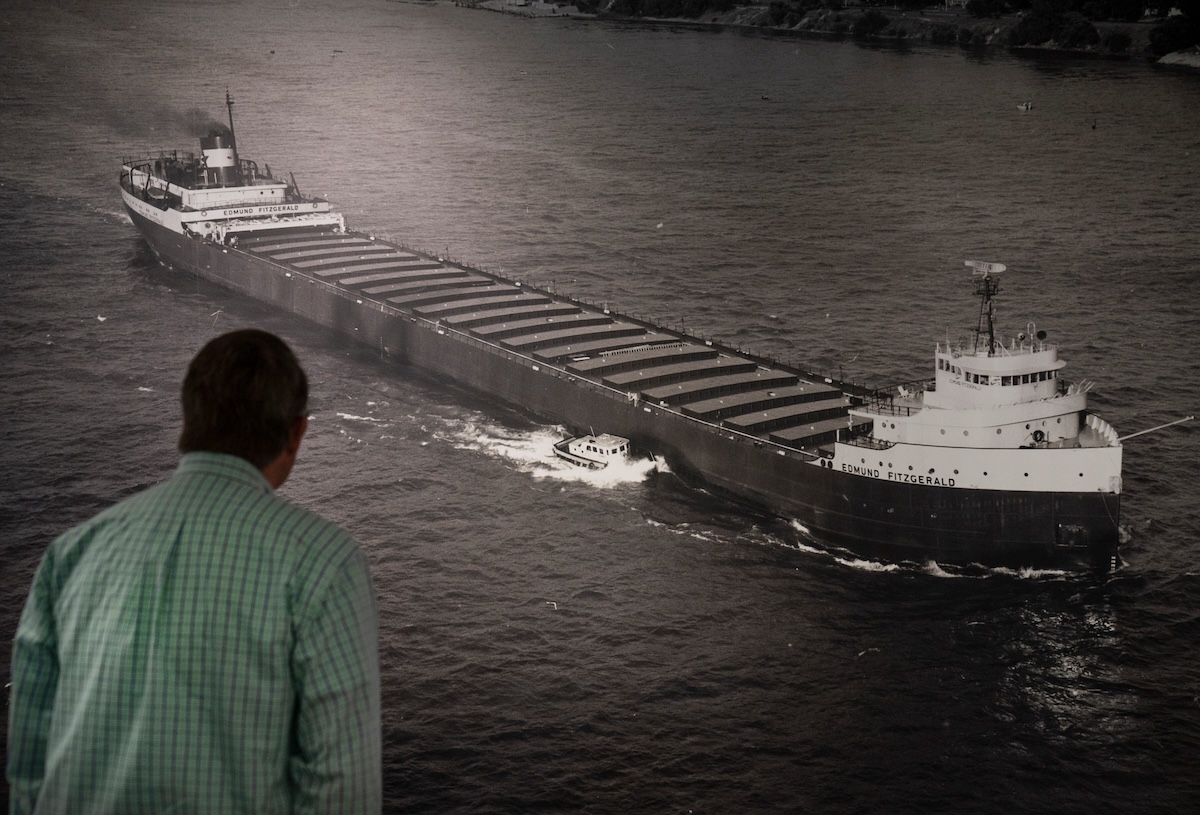
Richard Russell of Grosse Pointe Shores looks at a large photo of the SS Edmund Fitzgerald, which is featured extensively at the Dossin Great Lakes Museum on Belle Isle, on Friday, Oct. 24, 2025. Russell built a scale model of the freighter. Source: USA TODAY Network via Reuters Connect
Fifty years ago, on Nov. 10, 1975, the Edmund Fitzgerald sank in the icy waters of Lake Superior — a tragedy that still echoes across the Great Lakes.
“The legend lives on from the Chippewa on down of the big lake they call Gitche Gumee,” so begin the lyrics to one of the most famous songs of 1976, written by Gordon Lightfoot.
 Fifty years after the SS Edmund Fitzgerald sank on Lake Superior, its legacy endures through song, mystery, and Great Lakes history. Source: U.S. Army Corps of Engineers via Wikimedia Commons, colorized by Michael Koebnick
She’s been immortalized in photographs and lore. She sailed the Great Lakes. She was 729 feet long and had a single buff-colored funnel with white and red striping on both sides, her name engraved on the bow and stern. Named for the president of Northwestern Mutual Life Insurance Co., her name was no coincidence: the Edmund Fitzgerald.
Nicknamed the Mighty Fitz, the Pride of the American Side, Fitz, Big Fitz, Toledo Express, and Titanic of the Great Lakes, the ship carried taconite — a form of iron ore — from mines on Minnesota’s Iron Range near Duluth. From 1958 until November 1975, everything seemed routine. Her port of registry was Milwaukee, Wisconsin.
Then came Nov. 9, 1975.
The ship set out from Burlington Northern Railroad Dock No. 1 in Superior, Wisconsin. The destination: a steel mill on Zug Island near Detroit, Michigan. Accompanying her was the SS Arthur M. Anderson, a cargo freighter out of Two Harbors, Minnesota, carrying a similar load.
 Map showing the final routes of the SS Edmund Fitzgerald (red) and SS Arthur M. Anderson (blue) through Lake Superior in 1975. Source: USA TODAY Network via Reuters Connect
The conversations between the Fitzgerald and the Anderson were consistent throughout the voyage — including during the storm on Nov. 10, 1975 — as the two ships maintained radio contact, a requirement established after the Titanic disaster 63 years earlier. Unlike the Titanic, the Edmund Fitzgerald sank in a single night. The storm that sank her has been called by two names: the Gales of November and the Witch of November.
The Edmund Fitzgerald was carrying 27,300 tons of taconite iron ore from the Mesabi Iron Range near Duluth.
Following the wreck, Gordon Lightfoot, known for his song “Sundown,” wrote “The Wreck of the Edmund Fitzgerald.” Recorded and released a year later, in 1976, the song tells how all 29 men stayed on board — including the cook.
What really caused the wreck of the Edmund Fitzgerald?
Did the ship capsize?
Did she break apart at the surface like the Titanic?
Did she strike a rock, tearing a mammoth gash in the keel?
Unless new evidence is found — and the families of the 29 men aboard agree to further dives — the cause may forever remain shrouded in mystery.
One can only imagine how different it could have been — how different it would have been.
If only the past could be changed.
 A bronze leaf sits on display as a memorial for those lost on the SS Edmund Fitzgerald near the shoreline of Lake Superior outside the Great Lakes Shipwreck Museum at Whitefish Point in Paradise, Michigan, on Thursday, Oct. 30, 2025. Source: USA TODAY Network via Reuters Connect