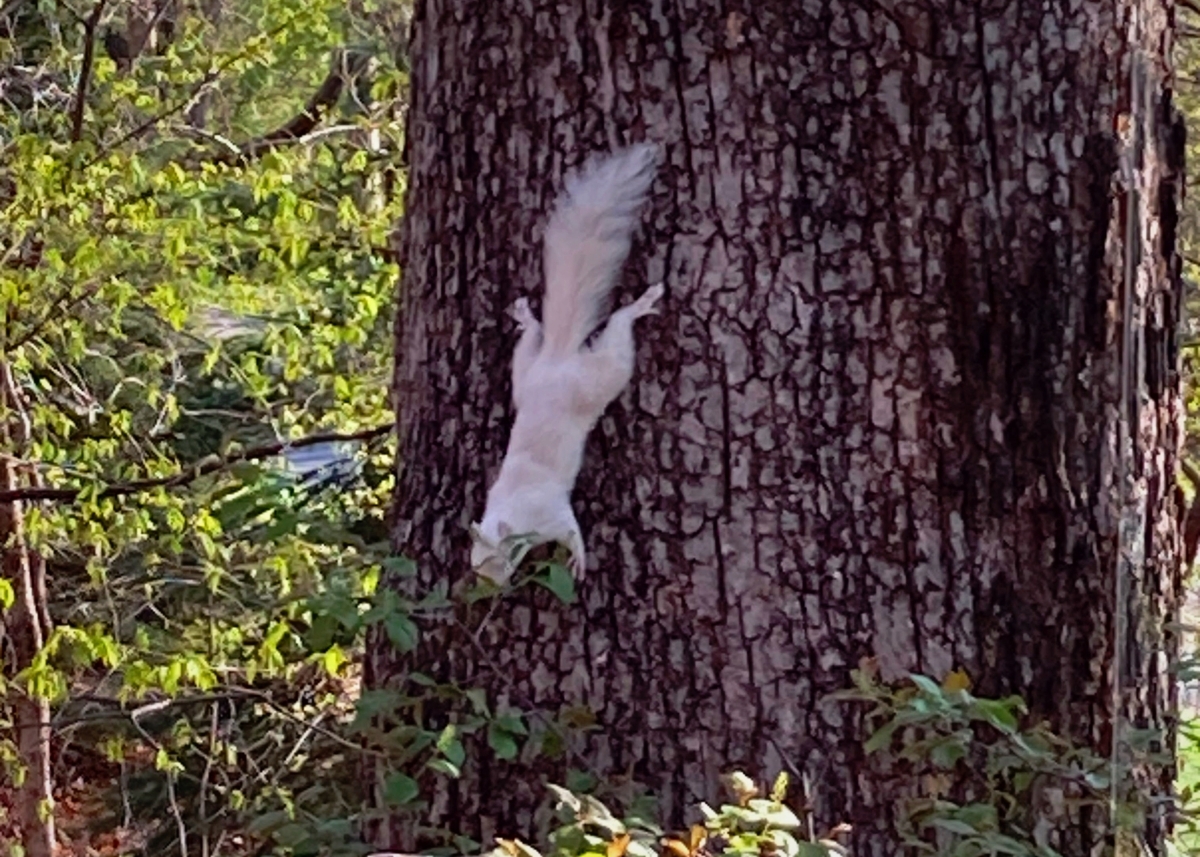
An albino squirrel climbs down from a tree to search for abundant acorns in the yards of homes on North Hillcrest Court. Photo courtesy of Jane Pixley
In some neighborhoods bordering the wetlands of Purgatory Creek, an unusual creature is captivating residents. With their brilliant white coats and startling pink eyes, albino squirrels are exotic and rare, comprising only 1 in 100,000 squirrels.
“That one is Snowflake,” said Jane Pixley, pointing to an albino squirrel that sat on her lawn, clutching an acorn. “She’s new to the neighborhood.” Across the street, another albino squirrel, Frosty, nimbly sprang on the limbs of the tall oak where it has nested for several years.
 “Snowflake,” an albino squirrel, visits Jane Pixley’s yard in search of acorns. Photo courtesy of Jane Pixley
Pixley, who has lived with her family for over 40 years on North Hillcrest Court, a quiet road on the northern edge of the marshes west of Purgatory Creek, has spotted lone albino squirrels for decades, but never in pairs. Based on that observation and sightings reported by friends and neighbors, she speculates that their numbers could be growing.
“Snowflake moved into a pine tree on our property a month or so ago. I don’t know if she’s related to Frosty, but I’ve seen them visit each other’s homes,” Pixley said, referring to the leafy dreys that squirrels typically build as nests. She added that a friend who lives about a mile away on East Franklin Circle, south of the wetlands and near Valley View Road, has recently begun seeing albino squirrels, too.
 Jane Pixley has noticed an increasing number of albino squirrels in her northern Eden Prairie neighborhood. Photo by Will Annett
Although human encroachment on wild environments often stresses native species and even drives some to extinction, albino squirrels might actually benefit by moving to the suburbs.
“In natural environments, these white squirrels would be picked off by predators — owls, foxes, and various hawks. They really stick out on a tree limb,” said Steve Woodley, senior research biologist with the Minnesota Department of Natural Resources (DNR) Farmland Wildlife Populations and Research Group in Madelia. “But in this human habitat where there’s fewer predators, camouflage coloration is less important. So, in a way, humans are protecting them.”
 “Rocky,” an albino squirrel named by EPLN photographer Rick Olson, frequented Olson’s yard in fall 2023. File photo by Rick Olson
Woodley explained that all albino squirrels carry a recessive gene that shuts down production of melanin, a pigment that produces color in fur and eyes. More common, but still quite rare, are leucistic squirrels, white-coated animals with dark eyes. Both genetic mutations are most often seen in gray squirrels, but occur in other squirrel species, too.
So, it is possible, Woodley noted, that the albino squirrel population is growing because individuals are surviving to pass on their genes, an evolutionary process called genetic drift. However, he added that the DNR does not currently track the number of albino or leucistic squirrels living in Minnesota.
Two years ago, Eden Prairie Local News photographer Rick Olson spotted an albino squirrel in his yard on the west side of town, near Rice Marsh Lake Park. He named that one “Rocky.”
 Pixley appreciates the visits of white squirrels and other wildlife to her yard. Photo courtesy of Jane Pixley
While survival of the fittest — or at least the best camouflaged — might prevail in the marshy fens and woody thickets just a block from her home, Pixley takes pride in seeing her yard become a kind of wildlife refuge. Deer often bed down beneath her pine trees while owls make homes in the boughs above. Coyotes, foxes, wood ducks and turkeys meander on the fringes. Raccoons patrol the property by night, and in the morning dozens of gray and red squirrels forage alongside their white-furred relatives.
She suspects the predatory instincts of some of these creatures are curbed by barking dogs, strolling humans and car lights. All to the benefit of her albino-squirrel friends.
“I love living here,” Pixley said. “It’s quiet and peaceful and we’ve got the whole natural world right outside our door.”