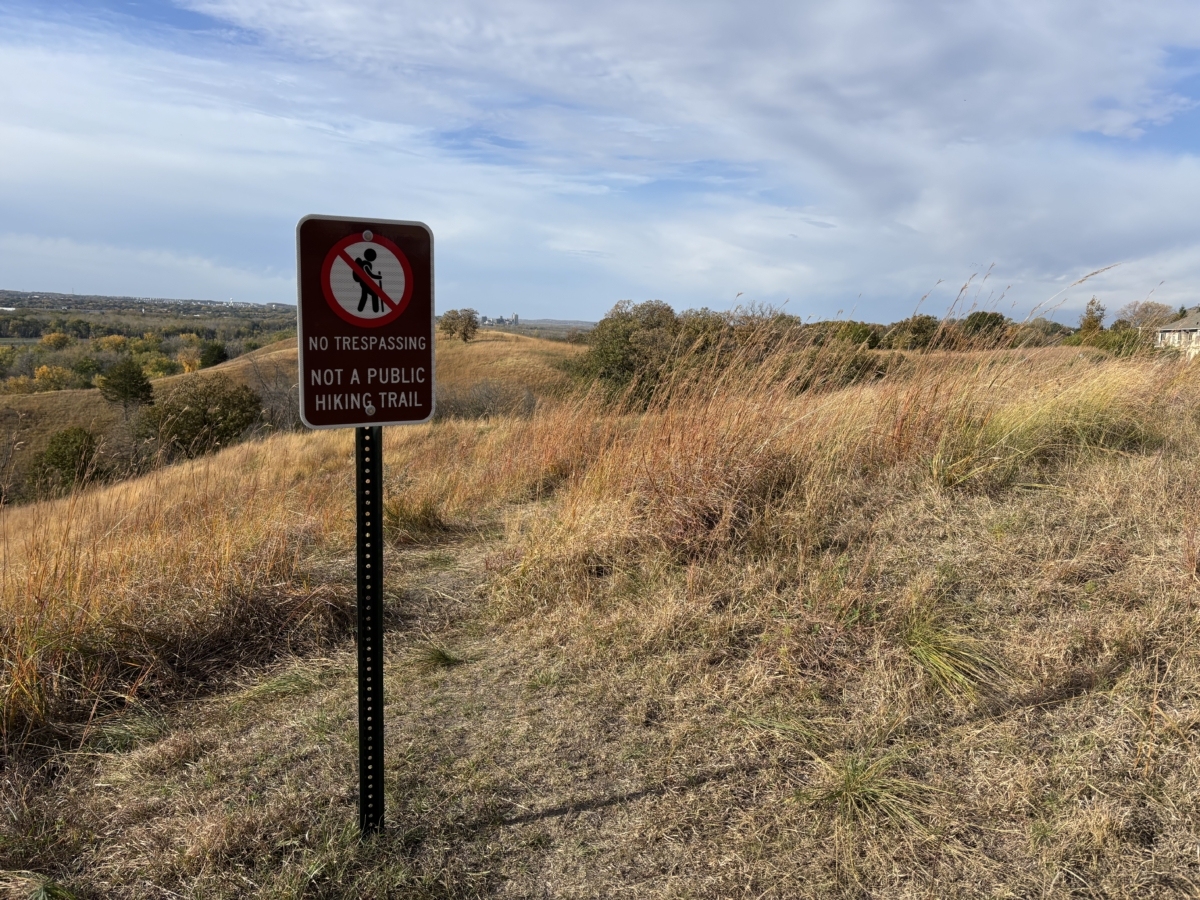
No-trespassing signs are posted near unofficial paths created by visitors going off trail. Photos by Jody Carey
Prairie Bluff Conservation Area, located on the south end of Eden Prairie, attracts both local residents and professional photographers for its natural beauty.
But neighbors and the city are asking visitors to stay on the paved path to prevent damage to the conservation area.
In September, the city added new signage, additional barriers and a mobile police camera at the entrance on Indigo Drive, as previous signage and barriers had failed to deter people from walking into the grassland.
“Concerned residents are the driving force behind why the closure has happened,” said Amy Markle, Eden Prairie parks and recreation director. “In response, we have fenced off the overlook point and closed access to the area so it can be restored from severe damage sustained from people going off trail.”
 A mobile police camera near the Prairie Bluff Conservation Area pavilion on Indigo Drive monitors and deters visitors from entering the protected grassland.
Prairie Bluff is different from local community parks or playgrounds. In a conservation area, nature comes first.
Karli Wittner, the city’s forestry and natural resources supervisor, gave me a tour of the area, pointing out the damage caused by people walking on delicate prairie plants.
“When we have people constantly treading the same path or going back to the same place over and over,” Wittner said, “it causes soil compaction, disturbs native plants and brings in invasive species.”
“I completely understand why photographers flock to this site, look at the view,” added Wittner as we walked through a closed-off area with sweeping views of the Minnesota River Valley.
The bare patches and meandering branches of footpaths appeared intentional.

 Foot traffic has damaged parts of Prairie Bluff Conservation Area, leaving patches of dirt where plants once thrived.
Some paths, as wide as three feet, looked like they had been mowed. But the trails were not intentional; they were formed by excessive foot traffic.
On our way back to the paved path, a group of about 10 young adults ducked under the single-chain barrier and walked on the path marked “No Trespassing. Trail Closed.” Wittner kindly explained to them that the trail was permanently closed.
As we headed back to the parking lot, a neighbor opened his living room window to thank Wittner for redirecting the group back to the paved path.
 A single-chain barrier and “No Trespassing” sign mark the closure of a trail damaged by heavy foot traffic.
Residents in the Hennepin Village neighborhood are passionate about Prairie Bluff and work with the city to help protect one of the last remaining native prairies.
But on social media, the scenic backdrop has inspired graduation, engagement and family photos, making Prairie Bluff an outdoor photo destination.
City officials said social media pages using the Prairie Bluff name are not affiliated with Eden Prairie.
Wittner has heard of groups using blankets, tables, balloons, chairs and couches for innocent artistic effect. “Photography off the trail in a protected natural area isn’t innocent. It’s habitat destruction,” Wittner said.
“Off-trail use has brought in other invasive species, buckthorn has encroached into the savanna and woodland areas, and erosion has begun.”
The city plans to address the damage in the near future and protect the legacy of Prairie Bluff.
Visitors and photographers are welcome to enjoy the beauty of Prairie Bluff and are asked to help preserve a rare ecosystem by staying on the paved trail.
Significance of Prairie Bluff Conservation Area
Prairie Bluff overlooks Grass Lake and the Minnesota River on the southern border of Eden Prairie. The area holds historical and ecological significance.
The city acquired the land through a 1994 referendum, when residents pushed for the bluff to be protected.
It is a remnant prairie, which means it is an original grassland that has not been plowed or disturbed. These types of prairies are extremely rare.
According to the Minnesota Department of Natural Resources (DNR), only 1% of the state’s native prairie remains.
Remnant prairies are home to plants that have existed for thousands of years, and the plant diversity in a remnant prairie is far greater than what can be restored.
The area was a sacred place for the Dakota people, who used controlled burning to stimulate new plant growth for bison to graze.
The Minnesota DNR, U.S. Fish and Wildlife Service, Hennepin County, watershed districts, and the Minnesota Board of Water and Soil Resources (BWSR) all use Prairie Bluff as a template for what a prairie should look like.
 Prairie Bluff Conservation Area is one of the last native prairies in Minnesota. The area is protected and used for research.
These agencies conduct research and seed collection, and join Eden Prairie residents in protecting one of the only remnant prairies in the metro area.
Prairies are more than flowers and grasses. Prairie habitat is critical for wildlife, migratory birds and pollinators.
Managing a prairie takes effort
Prairie grasslands require less rainfall, higher summer temperatures, grazing and fire to thrive.
Without natural fires and bison, prairies need human managers.
Eden Prairie reintroduced fire to Prairie Bluff in 2000. Fires stimulate flowering and seed production in prairie grasses and plants, encouraging new growth.
Wittner said that before 2000, the last fire was likely before 1862, when the Dakota people were removed from the area.
The soil along the hillside at Prairie Bluff is sandy and highly susceptible to erosion. Prairie plants have deep roots, up to 15 feet long, that are necessary to stabilize the soil.
“Without the plants holding the soil,” said Wittner, “it can very easily shift and erode, causing a cascading effect that means losing the prairie piece by piece.”
Something that took thousands of years to develop could diminish and erode into the Minnesota River — if people continue to stray off the trail.
“It sounds dramatic, but it has started to happen in some spots,” she said.
Fires in prairie biomes also help control the spread of non-native plants.
In the mid-2000s, beetles were introduced to control leafy spurge, a noxious weed that displaces native plants. Leafy spurge was introduced to Minnesota in 1890 when a bushel of oats from Russia contained leafy spurge seed.
The good news is that native cover has increased since the city purchased Prairie Bluff. “All the native species present today are there in the 1993 assessment,” said Wittner, but “more work needs to be done.”
 The entrance to Prairie Bluff Conservation Area is at 10092 Indigo Drive, where a small parking lot is available for visitors.
Visit Prairie Bluff Conservation Area
Prairie Bluff is a special place, and Wittner encourages people to visit.
“We want people to come to reconnect with nature, to enjoy the view of the Minnesota River Valley, and to see the wildlife,” she said.
“We simply ask that folks stay on the paved trail and take photos from the paved trail.”
Parking for Prairie Bluff Conservation Area is located at 10092 Indigo Drive, in a six-stall parking lot near the gazebo. Neighborhood streets are private, but additional off-street parking is available on Liatris Lane and Junegrass Lane, which are public roads.
Hiking in Prairie Bluff Conservation Area is no longer permitted. Visitors are asked to stay on the paved trail.
Open in Google Maps
More conservation experiences
• Explore Eden Prairie’s 14 conservation areas. • Volunteer to help protect native spaces with Friends of Eden Prairie Parks.• Learn more and volunteer as a prairie steward through the University of Minnesota’s Master Naturalist program.

Editor’s note: This story is the latest in an ongoing series called “Sustainability in Action.” The series spotlights sustainability efforts in Eden Prairie at various levels, from local government and businesses to community groups and residents. It includes a page dedicated to local, state, and national sustainability resources. This series has received support from a grant from the Eden Prairie Community Foundation.
If you have an idea for this series, contact the editors.