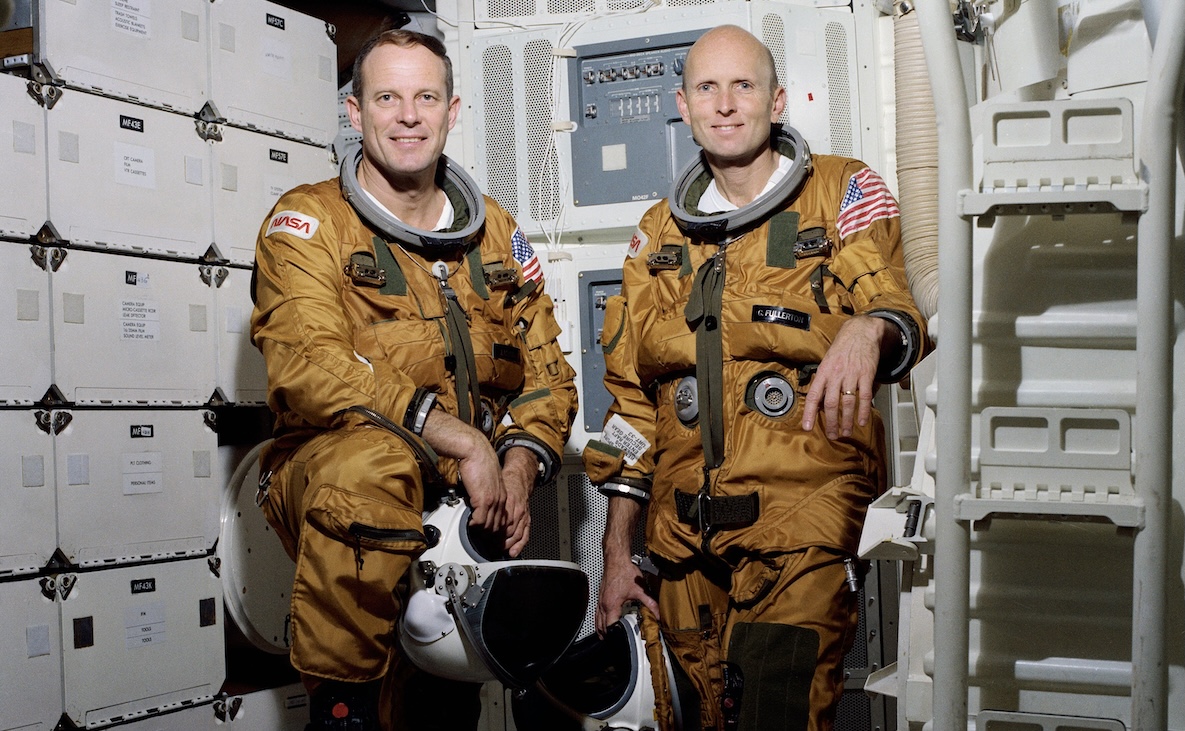
 Astronauts Jack Lousma, left, and Gordon Fullerton aboard the Space Shuttle Columbia during the STS-3 mission in March 1982. The two-man crew spent eight days in space conducting experiments and testing shuttle systems before landing at White Sands, New Mexico — the only time a shuttle has landed there. NASA photo
Few things have captivated the world quite like space exploration.
However, at 11 a.m. Eastern Daylight Time on March 22, 1982, the three RS-25 main engines of the Space Shuttle Columbia ignited, carrying astronauts Charles Gordon Fullerton and Jack Robert Lousma. Aboard the shuttle was an experiment prepared by 18-year-old Todd E. Nelson of Rose Creek, Minnesota. The experiment focused on the effects of weightlessness on bugs in space.
 A container holding insects, part of a biological experiment aboard the Space Shuttle Columbia in March 1982. The experiment, developed by Minnesota student Todd E. Nelson, tested how weightlessness affected insect behavior in orbit. Photo via Reuters/xpiemagsx
Nelson designed a miniature laboratory that consisted of a plastic box divided into quadrants. The laboratory consisted of queen bees, drones and centipedes.
The movements were observed using a special motion-picture camera throughout the flight. Upon reentry on March 30, 1982, the queen bees and their drones were found dead, while the centipedes were unscathed.
 The space shuttle Columbia lifts off from Kennedy Space Center’s Launch Complex 39 on March 22, 1982, to begin its third mission. Photo via Reuters/xpiemagsx
The Space Shuttle Columbia landed at White Sands, New Mexico, an approved alternate landing site. The runway at Edwards Air Force Base, typically used for shuttle landings, was flooded.
If the shuttle had landed on the wet runway at Edwards Air Force Base, here’s what could have happened: The shuttle, flying under its own power, would have given the astronauts no control over whether it came in gently or at a deadly speed.
If it had come in too steep, the orbiter Columbia likely would have skidded off the runway and crashed into something at Edwards Air Force Base, damaging the shuttle and possibly injuring or killing the astronauts.
That’s why the shuttle had to land at White Sands, New Mexico. The alternate landing site has since become known as White Sands Space Harbor.