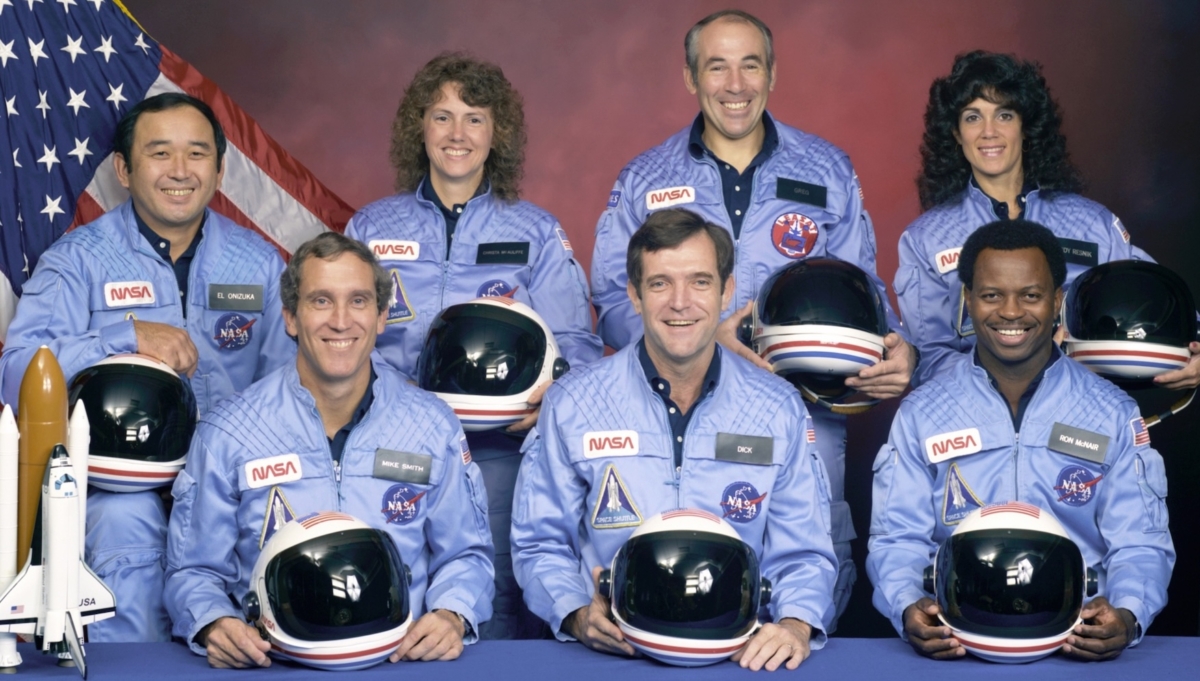
NASA's Space Shuttle Challenger (STS-51L) crewmembers are seen in this undated handout photo taken at Johnson Space Center in Houston, Texas. Left to right: Mission Specialist Ellison S. Onizuka, Pilot Mike Smith, Teacher in Space Christa McAuliffe, Commander Dick Scobee, Payload Specialist Greg Jarvis, Mission Specialist Ron McNair and Mission Specialist Judy Resnik. REUTERS/NASA/Handout (UNITED STATES - Tags: SCI TECH DISASTER) FOR EDITORIAL USE ONLY. NOT FOR SALE FOR MARKETING OR ADVERTISING CAMPAIGNS. THIS IMAGE HAS BEEN SUPPLIED BY A THIRD PARTY. IT IS DISTRIBUTED, EXACTLY AS RECEIVED BY REUTERS, AS A SERVICE TO CLIENTS
 The crew of the Space Shuttle Challenger (STS-51L) at Johnson Space Center in Houston. From left: Ellison S. Onizuka, Mike Smith, Christa McAuliffe, Dick Scobee, Greg Jarvis, Ron McNair, and Judy Resnik. Source: NASA via Reuters
It was the disaster that shocked the world.
Jan. 28, 1986, 11:38 a.m. Eastern Standard Time, Cape Canaveral, Florida, Launch Complex 39A.
The Space Shuttle Challenger’s engines ignited at T-minus 6.6 seconds.
But let’s go back to before the ignition of the Space Shuttle Main Engines (SSMEs).
The Space Shuttle Challenger was equipped with onboard computers designed to automatically launch the orbiter into space, provided nothing went wrong. The launch temperature was 36 degrees Fahrenheit, 15 degrees below the acceptable range for a shuttle launch.
Was Challenger destined for greatness? Or was it doomed from the beginning?
In October 1985, the Challenger launched successfully for its final mission, STS-61-A.
This was also when President Ronald Reagan selected two teachers for the STS-51-L mission: Christa McAuliffe as the primary candidate and Barbara Morgan as the backup in case McAuliffe became ill or injured. McAuliffe was set to be the first private citizen in space.
Then came the events of Jan. 28, 1986:
Mission Control: “We have a go for auto-sequence start. Challenger’s onboard computers have taken control of the orbiter for the remainder of the count.”
Auto-sequence start means the orbiter began running off its main onboard fuel cells.
Mission Control: “T-minus 10, 9, 8, 7, 6 … We have main engine start. 4, 3, 2, 1. And liftoff! Liftoff of the 25th space shuttle mission, and it has cleared the tower!”
Crew: “Houston, Challenger roll program.”
Mission Control: “Roger roll, Challenger.”
At 11:39 a.m. Eastern time, the fateful report and command were given:
Commander: “Engines begin throttling up. Three engines now at 104%.”
Mission Control: “Challenger, go at throttle up.”
Commander: “Roger, go at throttle up.”
Thirteen seconds later, all communication with the Challenger crew was lost. At 75 seconds, the Range Safety Officer destroyed the Solid Rocket Boosters.
 The Space Shuttle Challenger and its seven-member crew were lost when a ruptured O-ring in the right solid rocket booster caused an explosion shortly after launch from Kennedy Space Center on Jan. 28, 1986. This photo, taken moments after the accident, shows exhaust plumes from the shuttle’s engines and solid rocket boosters entwined around a gas cloud from the external tank. Source: NASA via Reuters
Steve Nesbitt, NASA’s public affairs officer (PAO), released the following statement:
“Flight controllers here are looking very carefully at the situation. Obviously a major malfunction. We have no downlink. We have a report from the Flight Dynamics Officer that the vehicle has exploded. The flight director confirms that. We are looking at checking with the recovery forces to see what can be done at this point.”
The nation mourned seven heroes that day.
At 5 p.m., President Ronald Reagan addressed the nation. “The future doesn’t belong to the fainthearted; it belongs to the brave. The Challenger crew was pulling us into the future, and we’ll continue to follow them,” he said in his four-minute speech.
Today, McAuliffe’s legacy lives on, with a school named for her in her home state of New Hampshire.
The Challenger Learning Center, also known as the Challenger Center, operates more than 40 locations across the United States, including in Florida, Ohio, New York, West Virginia, Illinois, Indiana, Missouri, Texas, Oregon, Colorado, and a planned facility in Minnesota.
International locations include Toronto, South Korea, and Leicester, United Kingdom.
The program, officially named the Challenger Center for Space Science Education, honors the legacy of the Challenger crew by inspiring students through science education.