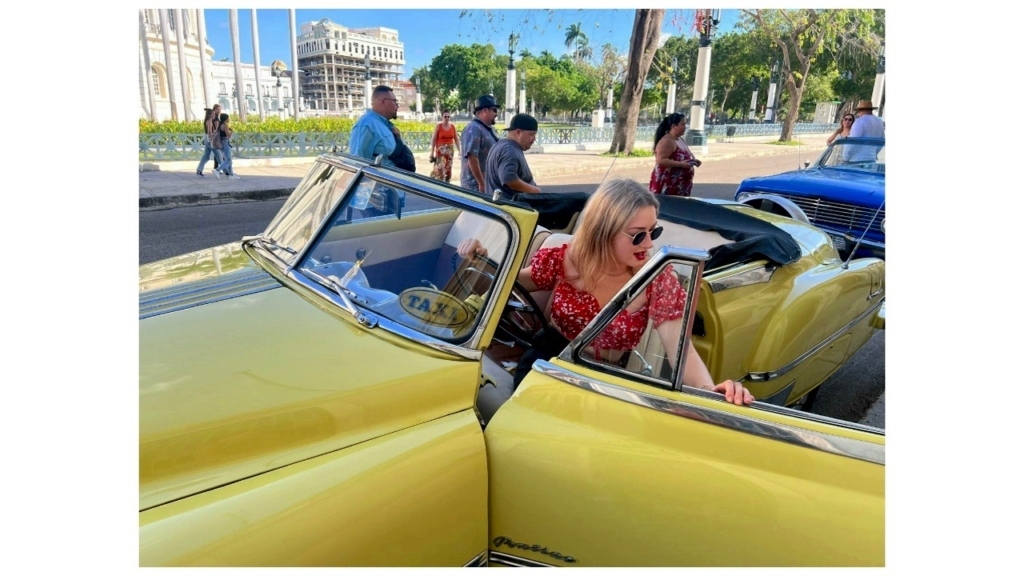
Amy Strate exits a 1950 Pontiac Chieftain in Havana.
Amy Strate shared her thoughts and photographs with Eden Prairie Local News about her first visit to what was once labeled a Soviet bloc country. Cuba remains an authoritarian nation only 105 miles from Key West, Florida.
The nine-day, January tour of western and central Cuba was organized by The Wanderlust Rose, a Twin Cities-based travel service. This trip was about cultural immersion, meeting people and sightseeing.
“Cubans are incredibly friendly,” says Amy. “Their cities, farms, mountains, even their restaurants, are scenic.”
The tour group of 16 looped by van from Havana and back with overnights in the historic towns of Viñales and Trinidad. They had time for swimming in the Caribbean, sightseeing from classic 1950s convertibles, Cuban cigar and rum sampling, and old-world market shopping.
 © Amy Strate 2024
“I liked the seamstresses and artists working and selling along cobblestone streets … the vintage Caddies and Pontiacs, hand carts and horse-drawn buggies,” said Amy.
My adventurous daughter has studied guitar and performance at the School of Rock Eden Prairie, taught snowboarding at Highland Hills, cut snow curves at Vail, traveled alone in Europe with cousins, and driven her Mitsubishi Eclipse GT around Brainerd International Raceway’s track. Cuba is in a slower, seldom-traveled lane, but that’s why Amy signed up with Wanderlust Rose.
American visitors to the Caribbean island nation remain subject to special restrictions. For example, the U.S. government permits travel to Cuba only if the visits fit one of 12 categories, including athletic competitions, educational and humanitarian projects and donations. The Wanderlust Rose group qualified for the latter at a hard-pressed fishing village that is having difficulty getting hurricane recovery supplies.
U.S. citizens must also stay in government-approved casas particulares. These private homes operate like bed-and-breakfasts but serve more than just cranberry scones and foil-wrapped butter pats as day starters. Amy says they prepare delicious breakfasts every morning with eggs to order, fresh-squeezed juice, guava, pineapple, and papaya fruit, along with Cuban coffee.
Viñales
 © Amy Strate 2024
In the rural town of Viñales, Amy and her travel pals, Nina DeAngelo (New Jersey) and Kelly Malone (Massachusetts), stayed with Señor and Señora Antonio, pictured above. Viñales is set in a rolling agricultural valley edged by ranges of low, sculpted mountains about 120 miles southwest of Havana.
 Viñales Valley sunset seen from an organic farm. © Amy Strate 2024
The sunsets from the veranda of the organic farm La Finca Agroecologia El Paraiso speak for themselves. The rich soils and microclimate of the Viñales Valley have earned international acclaim for the cigars made from tobacco grown by local farms.
 Emily Rose (straw hat, lower right) and her group pose for a photo at a Viñales tobacco farm. © Amy Strate 2024
Emily Rose, the “Rose” of The Wanderlust Rose tours, arranges trips like its January trek to Cuba. She partners with professional and multilingual local tour companies experienced with international travelers. Cuban Adventures provided the guides for the January tour.
Recent trips have included Guatemala (volcanos), Iceland (waterfalls and volcanos), Tanzania (African wildlife), Antarctica (penguins), Romania (villages and culture) and, yes, Minnesota (autumn backpacking the Superior Hiking Trail).
Although each trip provided countless selfie ops in exotic settings, Amy’s digital photos also framed Cuban life, landscapes, and culture that, 50 years ago, could have been rotogravure gallery ready. The following pictures are selected from Amy Strate’s Cuba portfolio.
 Tobacco aging shed.
Tobacco leaves are hung in sheds for drying. The Cuban Government buys 90% of the aged leaf from farmers for a set price. The leaf is transported to assembly shops or factories of boncheros (cigar-rollers). Farmers are permitted to sell only 10% of their own harvest on the free market, usually as hand-rolled, boutique cigars to tourists.

Amy’s group met 75-year-old Viñales tobacco farmer Señora Clara who was pictured in National Geographic Magazine a few years back. On the right, Emily Pollock watches Señora Clara’s partner hand-roll cigars.

A shelf in Señora Clara’s kitchen is not tagged with refrigerator magnets but with her National Geographic pics. On the right, tour organizer-guide Emily Rose and a client are framed by a tobacco shed window.
 Bay of Pigs, Cuba. © Amy Strate 2024
Bay of Pigs
In 1961, during U.S. President John F. Kennedy’s administration, a large, anti-revolutionary landing force of CIA-supported, exiled Cubans opposed to Fidel Castro was defeated at the Bay of Pigs. The Castro government and the Soviet Union were forming trade and military partnerships during the height of the Cold War in Europe. Travel restrictions for American visitors to Cuba were loosened during the Obama administration. These days, La Bahia de Cochinos and its colorful marine life attract snorkelers and scuba divers.
Trinidad
 Iglesia De La Santísima Trinidad (Church of the Holy Trinity) was completed in 1892. Located on Trinidad’s main plaza, it remains one of Cuba’s largest churches. © Amy Strate 2024
Founded in 1514, Trinidad is a UNESCO World Heritage Site. It embraces some of the best-preserved colonial architecture in the Caribbean. That history is deeply tarnished by the use of enslaved Africans to grow sugar for America and Europe. Cuba abolished slavery in 1886. These days, tobacco processing, tourism and cane sugar pump money into the local economy.
Amy found Trinidad’s architecture, shops, carts, and cobblestone street life relaxed but vibrant and artsy. “The cobbles,” she said, “are easy to walk on … but not with heels.“
 Dominoes is the national game of Cuba. The click-clacking of domino tiles underscores neighborly storytelling, rhubarbs and laughter on tables set up along streets and in parks. © Amy Strate 2024
 Celebrated potter Daniel Chichi Santander at the wheel in the Trinidad pottery/gallery named for him. Other potters work and show their work at La Casa Chichi. © Amy Strate 2024
Arte Encontrado de la Habana
 The weathered dignity of a Havana barbershop most likely speaks to its customers and stylists. © Amy Strate 2024
 Question: Bold graffiti or bold art? Answer: No impota! © Amy Strate 2024
 From the left, Amy Strate with guide Yanet Cabrera and Nina DeAngelo with street cats. © Amy Strate 2024
Cuban Adventures guide Yanet Cabrera speaks English, French and Spanish, is married and has two daughters. On the right, a quartet of Havana street cats are charmed by one of Amy’s travel pals, Nina DeAngelo of New Jersey.
 Amy Strate with El Caballero de Paris statue. © Amy Strate 2024
A courtly and stylish homeless man, known as El Caballero de Paris (The Gentleman of Paris), handed out drawings and theatrically recited passages of Spanish literature on the streets of Havana, most famously during the 1950s. José Maria López Lledína actually came from Spain. His peculiar life has inspired a biography, paintings, many articles and at least one song and two statues. Urban legend holds that if one steps on the shoe, holds the finger and tugs the beard of the bronze El Caballero statue at Basílica Menor de San Francisco in Havana, a wish can come true. Amy cannot recall her wish.
 Fusterlandia is nested in the western seaside outskirts of Havana. On the right is a typical lobster entrée. © Amy Strate 2024
Fusterlandia is a surreal enclave of bungalows, gardens, and streets upholstered with colorful pottery shards and tiles. Folk artist José Fuster’s work-in-progress began in 1975. Others have joined in. They have provided a tired and sad neighborhood with zip and international fame. Havana’s building codes are clearly more accommodating than Eden Prairie’s. The typical Cuban restaurant entrée on the right may have inspired Fusterlandia. The plate is piled with buttery lobster chunks, shredded cabbage, and slices of plantain, tomato and cucumber.
Vintage American cars
 This pink Chevy convertible, likely a 1952 Bel Air, serves as a Havana taxi. © Amy Strate 2024
 © Amy Strate 2024
On their second day in Cuba, The Wanderlust Rose travelers toured Havana in six vintage Detroit-made convertibles from the 1950s. Amy explains that new engines and other parts have been replaced or tooled to keep them running. The looks of these assembly line beauties have been carefully curated. Thank you, Cuba.
Editor’s note: Writer Jeff Strate is a founding member of the EPLN Board of Directors. Amy Strate is a lifelong resident of Eden Prairie and an enthusiastic world traveler.