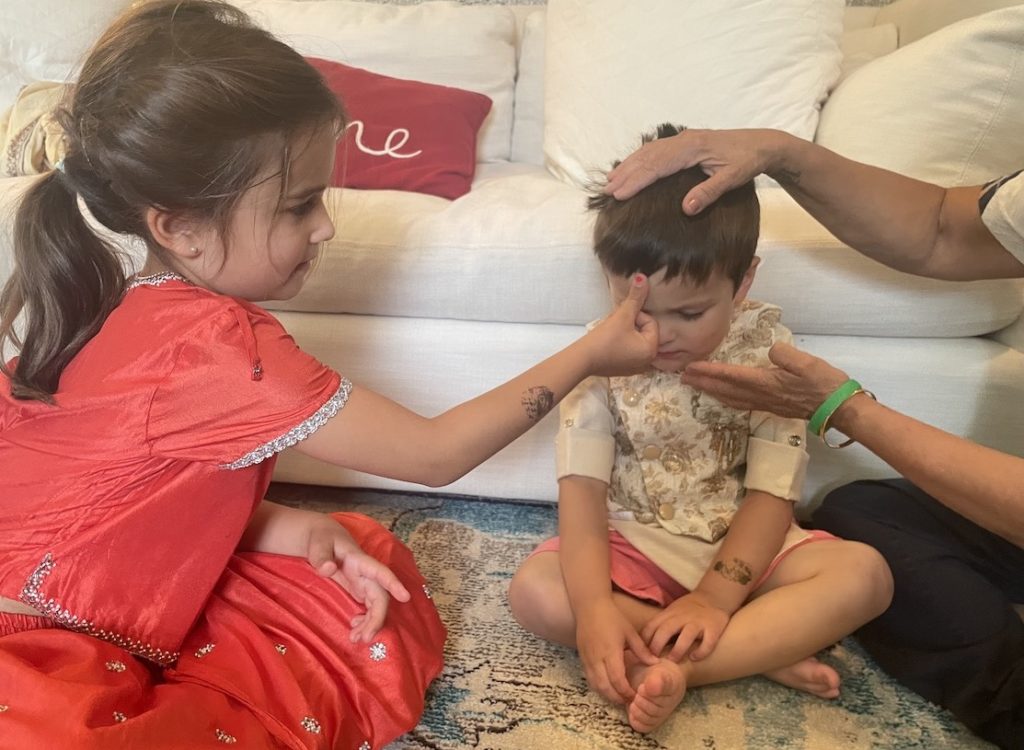
Sia Lowther, 5, blesses her brother Bodhi, 2, at the start of the observation of Raksha Bandhan on Sunday, Aug. 22. Photo by Vijay Dixit
India is the land of festivals. Each conveys a message of harmony, be it with family, community, nation, the world, or the cosmos.
These festivals—spaced out at regular intervals during the year—have been an integral part of India’s culture over millennia.
 As part of the ceremony, Sia Lowther ties a rakhi on her brother Bodhi’s wrist. Rakhi signifies the pure bond between brothers and sisters. Photo by Vijay Dixit
Celebration of these festivals is the mechanism chosen by the ancient sages to reinforce the above messages regularly. Otherwise, they would get lost with time.
Here we are, centuries later, celebrating those festivals.
Raksha Bandhan is one such festival that comes in the month of Shravana, the rainy season in the Hindu lunisolar calendar.
This year, the celebration occurred on Sunday, Aug. 22.
It may have Hindu origins, but its more profound message of love and caring among brothers and sisters is universal and transcends religious and ethnic boundaries.
The Sanskrit word Raksha Bandhan means a bond of protection, a symbolic renewal of one of the most pious emotional relationships among humans, between a sister and her brother.
As per the tradition, the sister ties a sacred ceremonial band of cotton called rakhi on her brother’s right wrist and prays for his health and prosperity. The brother, in return, pledges to protect her unconditionally throughout his life.
 Sia Lowther makes sure the rakhi is properly tied to her grandfather’s wrist. Photo by Vijay Dixit
The festival is special for young children because they can choose from hundreds of brightly decorated and colorful bands displayed at local markets and malls.
After the ceremony, children go around showing their brightly decorated rakhis with pride to their friends. Their innocence creates an aura that is a spectacle to watch.
In the United States, brothers and sisters with Indian roots continue to carry out the tradition.
Those sisters geographically away from their brothers ship the rakhis across the country and, in many cases, across continents.
The message of protection and prosperity in Raksha Bandhan is now inspiring cause-based advocacy efforts for building safe and prosperous communities on multiple fronts.
The clue for advocacy came from India’s Nobel laureate Rabindranath Tagore.
In 1905 he used Raksha Bandhan as a springboard for hope and spread harmony among people in India. He turned Raksha Bandhan into a movement calling for communities of all faiths to come together and exchange and tie rakhis.
 A rakhi display at a mall in New Delhi, India. There are similar shops selling rakhis across India and Indian stores in the U.S. Photo by Harsh Rampal
For Indians, he wanted rakhi to serve as an ironclad symbol of protection against the divide and rule policies of British colonialists who ruled the country at that time.
Tagore’s idea is still valid in today’s India, starting new initiatives and enhancing existing ones on the day of Raksha Bandhan.
Numerous community organizations conduct special educational programs and workshops to help protect citizens from pollution, poverty, inequity, illiteracy, and distracted driving.
In Eden Prairie, an annual Raksha Walk event is organized to protect drivers from distracted driving behaviors.
Today, Raksha Bandhan has secured a special status in society by evolving its message in step with changing times.
Disclosure: Raksha Walk is sponsored by the Shreya R. Dixit Memorial Foundation chaired by Vijay Dixit, an Eden Prairie Local News board member.
 A Rakhi ceremony setup by a sister. The Raksha Bandan festival signifies the love, protection, loyalty, care and commitment a brother and sister have for each other. Photo by Vijay Dixit